Addictions and Recovery Consulting
What weekly drinking does to a year of training
I want to show you something that took me a long time to understand, and that I now think is the single most important thing the tracking has taught me.
Past about thirty, if alcohol is going in most weeks, health progression is very close to impossible.
Not weight loss. Not looking better. Those are still available, and that is exactly what makes this hard to see. What becomes unavailable is the thing the training was supposed to buy you — the recovery, the autonomic capacity, the numbers that predict how long and how well you live.
A hypothetical year
Everything that follows is hypothetical, and it has to be. The charts are the output of a predictive model, not anybody’s watch.
That is a privacy requirement, not a shortcut. A client’s heart rate variability, sleep and drinking days are personal health information. Under Canadian privacy law I cannot publish that, and I would not want to even if I could — anyone who hands me a year of their life is entitled to expect it stays between us. So no client’s data appears here and none ever will. What you are looking at is a projection for a person who does not exist.
What the model does is take the published effect sizes — what a drink costs HRV and resting heart rate on the night, how the autonomic system decays back afterwards, what a training block buys you — and run them forward across a year for one person. It is a projection built on measured numbers, not a drawing.
The shape that comes out is also what I have watched happen to people who train seriously and drink most weeks. That is why I trust it enough to put it on a page.
So: a hypothetical man in his forties. Two hours of training most days. The full Resilience Therapy protocol: strength work, cardio, time outdoors, time with people, deliberate parasympathetic work — all of it held steady all year. Four twelve-week blocks, and at each boundary one training variable changes and nothing else does. Weights added. Trail running added. Weights taken away. Weights put back.
And he drinks two or three times a week. One hundred and twenty-one days out of three hundred and sixty-five.
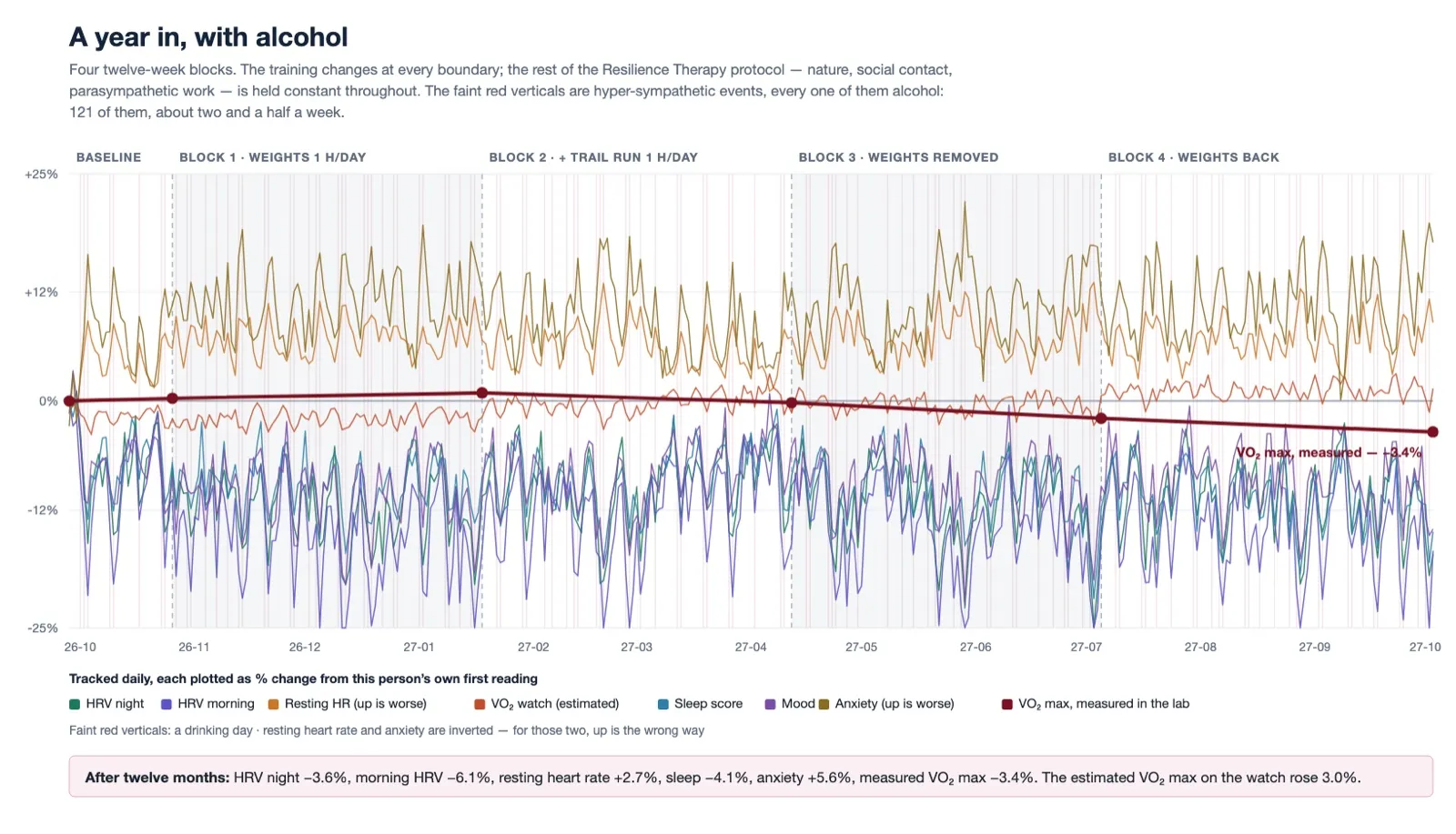 Every faint red line is a drinking day. The heavy dark line is measured VO2 max at each assessment.
The training changes four times. Look at what it does to the shape of the year.
Nothing. The blocks are almost indistinguishable. Whatever the training was doing, something larger was doing the opposite.
Five weeks of it, close up
Here is why. This is the same year, five weeks of it, built around the only eight-day stretch in the whole twelve months with no drinking in it.
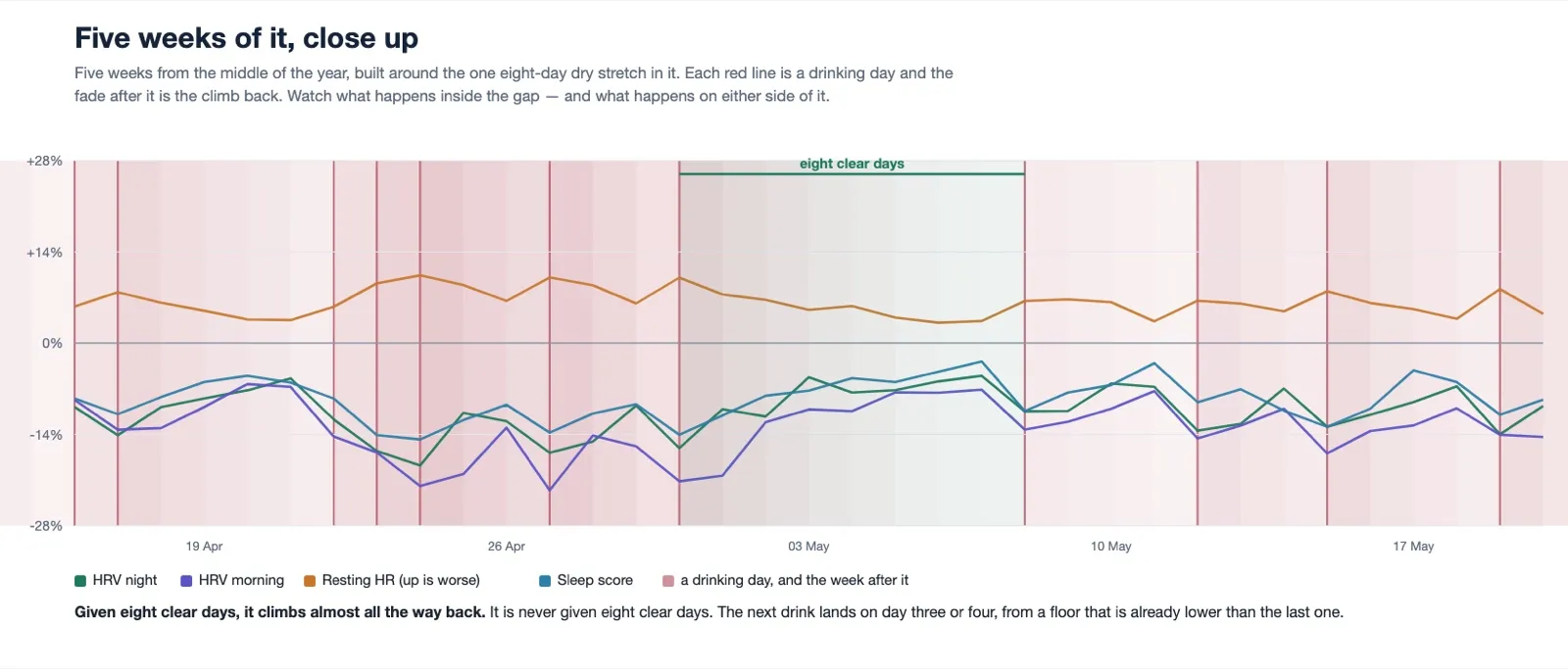 The green band is the one eight-day gap in the year.
Inside that gap, everything climbs. HRV overnight, HRV in the morning, sleep quality — all of them walk steadily back up toward the line. The body knows exactly what to do and it gets on with it.
Then the next drink lands and it all goes over again.
What the research actually says, and what it does not
I want to be careful here, because this is where it would be easy to overstate and I would rather you trusted the rest of the page.
What is very well established is the nightly cost. In a study of nearly 21,000 people across five million person-days, one drink more than somebody’s own average cost them about 2.4 to 2.8 beats per minute on resting heart rate and 3.3 to 3.8 milliseconds of HRV that night. One drink. In 4,098 Finnish employees, overnight recovery fell by 9% at about one drink, 24% at three, and 39% at seven.
It is still there the next morning. Three separate randomised trials found resting heart rate four to seven beats higher the morning after, with a blunted baroreflex — the reflex that manages blood pressure. You have not slept it off.
Two findings from that same large study are worth knowing. Training harder on a day you drink makes the autonomic hit worse, not better. And sleeping longer afterwards recovers more of it than anything else measured — the single biggest thing within your control on the night.
REM sleep is disrupted from about two drinks, according to a meta-analysis of 27 studies.
And people who drink more have measurably lower resting HRV. In 542 healthy men, the heaviest-drinking third had lower HRV than the other two.
Here is what nobody has published. No study has followed HRV day by day back to baseline after a drinking episode in healthy people. The longest continuous monitoring is 48 hours, and it shows the parasympathetic system rebounding by the second day rather than staying down. So the idea that two or three episodes a week never lets recovery finish is a reasonable hypothesis and not a proven fact. It is what I think the tracking shows. It is not something I can point at a paper for.
I am telling you that because you could check, and because the gap is genuinely interesting — it is one of the questions I would like to answer properly.
And the best-evidenced part is the most useful part: it comes back. In 33 habitual drinkers, cutting intake roughly in half for three weeks measurably raised HRV and lowered resting heart rate. Not months. Three weeks.
And here is the part that fools people
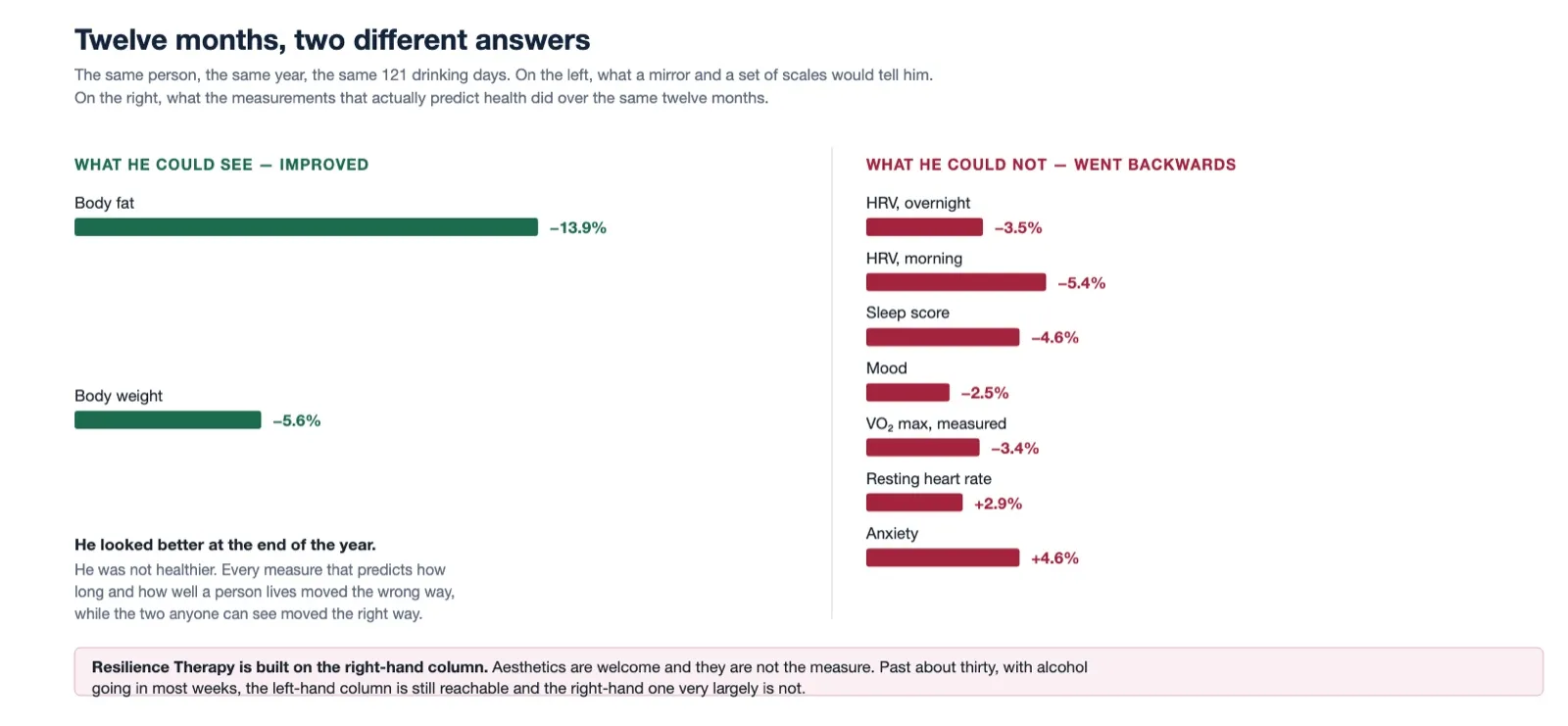
Over that same year, his body fat dropped almost fourteen percent and he lost weight. He looked better in the mirror in September than he had the previous October. Clothes fitted differently. People told him he looked well.
He was not healthier. He was measurably less healthy than when he started:
| Twelve months | |
|---|---|
| Body fat | −13.9% |
| Body weight | −5.6% |
| HRV overnight | −3.5% |
| HRV morning | −5.4% |
| Sleep score | −4.6% |
| Mood | −2.5% |
| VO2 max, measured | −3.4% |
| Resting heart rate | +2.9% |
| Anxiety | +4.6% |
Two hours of training a day for a year, and the measure of aerobic capacity went down.
One more thing worth noticing. His watch said his VO2 max went up three percent over the year. The measured test said it went down three and a half. A watch estimates VO2 max from the relationship between heart rate and pace — it was reading the training, honestly enough. It had no way to see what the drinking was doing underneath.
Why this matters more after thirty
Under twenty-five you can do almost anything to a body and it will absorb it. That is not a moral fact, it is a recovery-capacity fact, and it does not last.
Past about thirty the margin narrows. Past forty it narrows again. The same two drinks cost more nights of recovery than they used to, and the training you are doing to build capacity is competing against something that is taking it away faster than you can add it.
Which is why aesthetics keep improving while health does not. Fat loss answers to energy balance and training volume, and both of those are still under your control. Autonomic recovery answers to what you do the other twenty-two hours, and that is where the drinking lives.
What this means for Resilience Therapy
This is why Resilience Therapy is built on the health measures and not the mirror.
Aesthetics are welcome. They are not the measure. If you get leaner while your HRV falls and your resting heart rate climbs and your sleep gets worse, the programme has not worked, whatever the photographs say. I would rather tell you that than take your money for a year and show you a before-and-after.
And if alcohol is going in most weeks, I will say so early, because I do not want to sell you twelve weeks of work that the other twenty-two hours a day will cancel out. That is not a moral position. It is what the numbers do.
This is also where I stop and the counsellor starts. I am a trainer. If drinking is the thing in the way, a qualified addictions counsellor and a programme come first, and the training works alongside them — never instead. The places to start are listed on the addictions and recovery page.
Why I care about this one
I supported my wife through her addiction for years. Multiple rehabs, detoxes and hospitalisations. In the end we separated, and she died in late 2025.
I did not have any of this then. No watch, no overnight HRV, no record of what a week of drinking did to her recovery and how long it took to come back. What I had was what I could see — and I could see it. I knew which days were different. I could tell by looking at her, on the days she had trained, that something had changed that I had no way to name or measure.
What I have now is the instrument I did not have then. It does not tell me anything I did not already know from watching. What it does is make it arguable. It turns I can see it in your eyes into a line on a chart with a number on the end of it, and some people need the number.
That is the whole reason I built this.
Every number in the charts above is modelled rather than measured. No client’s data is used, because it is personal health information and publishing it would breach both Canadian privacy law and the promise I make to everyone I work with. See the privacy page. The research the model is built from is in the column beside this article.