How it works
This is a measurement-led practice, and this page is what that means in practice.
Nothing here is a mystery and nothing is rushed. Before any training is written, there is a baseline — several days of it — because a programme built on a guess can only be judged by a guess.
Here is the whole thing, in order.
Not in the Shuswap? There is a remote version — a tracking and analysis programme for people who already know how to train.
1. A free consultation
Twenty minutes, no charge, no commitment.
We talk about what you want, I explain what Resilience Therapy is, and we find out whether we are a good fit for each other. If we are not, I would rather say so here than three months in.
There is a form further down this page that will write the email for you. It asks five short questions and nothing medical — the health questions happen in person, later, and never online.
2. Assessment and intake
The first session together. We go through your history, your injuries, what you have tried, what you are actually after, and anything that changes what is safe for you to do.
You can read the intake form before you come. Here it is as a PDF — every question I will ask, so none of it is a surprise and you can think about the answers in your own time rather than on the spot.
The health part we go through together, face to face. Not online, not by email, not on a form you send in. There are three reasons and they all matter.
The first is that it is a conversation, not a questionnaire. “Bad knee” written in a box tells me almost nothing; two minutes of you describing when it hurts and what you stopped doing because of it tells me what to change about your programme. Things come up in that conversation that no form would have asked about.
The second is that some of it is hard to write down. People leave things out of forms that they will say out loud once they have met you, and the things they leave out are usually the ones that matter.
The third is plain: your medical history is not going in an email. A form on a website either sends your conditions and medications as plain text or hands them to a company neither of us has vetted. Paper, in person, kept under a code, is the honest way to do it.
Two other things get signed at that first session and neither is on this page: a release of liability, which I hand over on its own so you can read it properly, and the Get Active Questionnaire, which is the standard pre-exercise screening in Canada. Nothing physical happens before that one is done.
This is also where you meet the tracking. There are two apps behind the work, and only one of them is yours.
RizunResilience-Daily is the one you use — the daily record. A couple of minutes a day, and most of it fills itself in. RizunResilience-Assess is my tool; I run it on your testing days. You will see it, because I would rather you knew what I was doing with your numbers, but you never have to learn it.
So there is one thing to get comfortable with, not two. Both are described in the column beside this, and there is a practice version of the daily one further down that you can type into.
I will walk you through it in person too, with a worked example, so you can see exactly what gets recorded before you record anything. It comes with the coaching at no extra charge — no subscription, nothing to renew.
Sixty to ninety minutes, charged at the ordinary session rate by the hour — the same as any other hour of my time. Nothing about this stage costs extra. The rate is on the Rates page.
3. Two baseline days, on your own
Before anything is measured properly, I need to know what an ordinary day looks like for you.
You complete two more baseline entries in RizunResilience-Daily, with at least one day between them. This is just the daily routine — the questions take a couple of minutes. It is also when we sort out your tracking. A Garmin watch is the preference, because it gives the overnight numbers without you having to do anything, but we will work with what you have.
Two days a week apart tell me more than two days in a row. One bad night’s sleep should not become your baseline.
What you track is up to you
If you want to know what the lights on the back of a watch are actually doing, and how closely they agree with a hospital ECG, that is written up here: the green lights on the back of your watch.
Track whatever you want. I encourage a Garmin watch and HRV4Training — Garmin for the overnight numbers and HRV4Training for a one-minute morning reading — because between them they cover the two sides of recovery without much effort from you. Everything else in the daily entry is your choice.
The more you fill in, the more the record can tell you. Someone logging only sleep and mood still gets something useful. Someone logging training hours, time outdoors, alcohol and how they felt gets a far better answer to what actually changed this. None of it is compulsory and a blank is always better than a guess.
One thing you can do tonight
Body fat gets measured properly at the physical assessment. If you want a number before then, there is the tape test — the estimate the US Navy has used since 1984, which needs a tape measure and two minutes. It is an estimate and the page says so plainly, but it gives you a starting point that is yours, taken before anything changed. Take the test.
The day closes
The app will only take an entry for today or yesterday. The date box does not offer anything else.
Yesterday is allowed on purpose — last night’s sleep and HRV do not reach the watch until the morning, and an evening session often gets written up the next day. After that the window shuts.
This is deliberate and it is not about discipline. A number remembered three days later is not a measurement, it is a reconstruction, and it will quietly wreck the very comparison you are paying for. A gap in the record is honest. An invented Tuesday is not.
4. The physical assessment
Now the testing, built around what the baseline data already shows.
Two sessions of an hour each, with two days between them for recovery. The gap is not padding. Testing you while you are still sore from testing you measures the fatigue, not the fitness.
Both are charged at the ordinary hourly rate, the same as any other hour — two hours in total. Nothing about the testing carries a premium.
What you get back
A written breakdown of the whole thing. Not a spreadsheet — an actual explanation.
- Every test, and what the number means. In plain words, not jargon.
- Your strengths and your weaknesses, named. Most people come out of this uneven, and the uneven bits are where the programme goes to work. Knowing you are strong in the legs and weak through the posterior chain is more useful than any single score.
- Where you sit against everyone else. Your results against Canadian norms for your age and sex — percentile values published by Statistics Canada from the Canadian Health Measures Survey, which measured over five thousand Canadians aged 3 to 79 directly rather than asking them. So you can see roughly where you fall, rather than staring at a number with nothing to measure it against. The sources are on the references page.
Most people have never had any of this. Being told you have the aerobic capacity of someone ten years younger, or that your grip strength is in the bottom quarter for your age, is the kind of thing that changes what somebody does on a Tuesday.
One caution, and I will say it every time. Population norms are a rough guide, built from other people. They are useful for orientation and they are not a verdict. They also age: the most recent published Canadian fitness percentiles come from survey data collected over a decade ago, and the country has not stood still since. The comparison that actually matters is you against yourself twelve weeks from now — same tests, same equipment, same operator. That is the one nobody else can give you and it is the whole reason for doing this properly.
5. Training starts the following week
From your baseline, your assessment and what you actually want, I build the programme. It uses the whole range — resistance training, aerobic work, time outdoors, sleep, nutrition and deliberate down-regulation — in the proportions your own numbers argue for, not a template.
6. The twelve-week block
Training blocks run twelve weeks.
The first two to six weeks are with me, depending on how much time you have spent in a gym. Someone who has trained for years needs less of my time than someone who has not. The goal is that you can run the programme yourself — I am trying to make myself unnecessary, not indispensable.
7. Reassessment, and one thing changes
At the end of twelve weeks we do the full set of assessments again, the same way, on the same equipment.
Then the plan changes based on what the numbers actually did — and, wherever possible, only one variable changes at a time. That is slower than overhauling everything at once, and it is the only way either of us can tell which part did the work. Change four things and improve, and you have learned nothing you can use next time.
8. The twelve-week findings session
After each round of testing there is a ninety-minute findings session, at the same hourly rate as everything else, to go through it properly: the same written breakdown as the first time — every test, your strengths and weaknesses, where you sit against the norms — but now with the thing that first one could not have. What changed, and by how much.
What moved, what did not, what it means, and what the next block is going to do about it.
Not a number emailed to you. A conversation.
Then it repeats
There is no step nine. After the findings session the whole thing starts again from step five: a new twelve weeks, the first two to six alongside me until you are comfortable on your own, then the reassessment, then the next twelve-week findings session.
Over a year that is four blocks, four full assessments, and a record of your own that is long enough to show something real.
You need me less each time
The one-on-one gym time goes down as you go on. Two to six weeks at the start of the first block, because you are learning the movements and I want eyes on them. Less in the second block. Less again in the third.
By the fourth you know what you are doing. You know the lifts, you know what a hard session is supposed to feel like, you know what your own numbers look like on a good week and a bad one. Paying somebody to stand beside you at that point is paying for company.
The assessments do not stop. Nor do the blocks, nor the changes to the plan. That part carries on whether I am in the room for the sessions or not — every twelve weeks, the full set of tests, the same way on the same equipment, then a plan built on what actually moved.
Where this is going
You become your own experiment.
Not as a figure of speech. An actual one, run on the only subject whose results you will ever act on.
The point of all of it is that you end up able to do this yourself. Not “keep training” — anybody can keep training. I mean you end up able to build your own year: four blocks, twelve weeks each, changing one thing at a time and measuring whether it worked.
Baseline first. Change one variable. Hold everything else still. Measure the same way you measured before. Look at what moved, and take out what did not.
That is what makes it a real test rather than a story you tell yourself afterwards, and it is worth being exact about why:
- It is testable. The block can fail. You can set out to improve something, measure it twelve weeks later, and find it worse. If a plan cannot come out wrong it was never telling you anything.
- It is valid. Same tests, same equipment, same person running them, same conditions. When the number changes, the change is in you and not in the method.
- It is repeatable. Do the block again and you should get the same answer. Do it on somebody else and you find out whether it was you or the training.
- It is controlled, as far as one person can be. One variable at a time, everything else held, and the days that were not training marked so they are not silently blamed on the programme.
That is the same apparatus a study uses. Applied to one person, it does not prove anything about anybody else — and it does not have to. It only has to tell you the truth about you, which is the one thing a population average can never do.
The app is what makes that possible for one person on their own. It holds the baseline, it marks the blocks, it flags the days that were not training, and it shows you what moved with what. Without it you are relying on memory, and memory will tell you whatever you already believed.
None of this was possible twenty years ago
Measuring your own nervous system used to mean a laboratory, an appointment and somebody else’s equipment. Heart rate variability, overnight respiration, sleep architecture, resting heart rate to the beat — these were research measurements. You did not have them. You had how you felt, and how you felt is a poor witness.
Now they are on your wrist while you sleep, for the price of a watch.
That is the change, and it is a recent one. The apparatus a study needed in 2005 is a consumer device in 2026, and it runs every night without being asked. What used to need a university now needs a watch, a phone, and the discipline to write the rest down.
The discipline is the part nobody sells you. A watch full of numbers that nobody reads is a fitness tracker. The same numbers against a baseline, in blocks, with one variable changing at a time, is evidence.
What I am actually selling
Not sessions. Sessions are the delivery.
What you are buying is independence, and the thing that makes independence possible, which is knowing. Knowing what your own baseline is. Knowing what a hard week does to you and how long it takes to come back. Knowing which of the things you do actually moves the numbers and which ones you only believe in. Knowing, when somebody sells you the next protocol, how to find out for yourself whether it works.
You come for the coaching. You leave able to design your own training the way a researcher designs a study, and able to tell for yourself whether the next thing you try is working.
Then you carry on without me, and I would count that as the job done.
What the record looks like
Both of these are a worked example — invented numbers, so you can see the shape of the thing before you have any of your own.
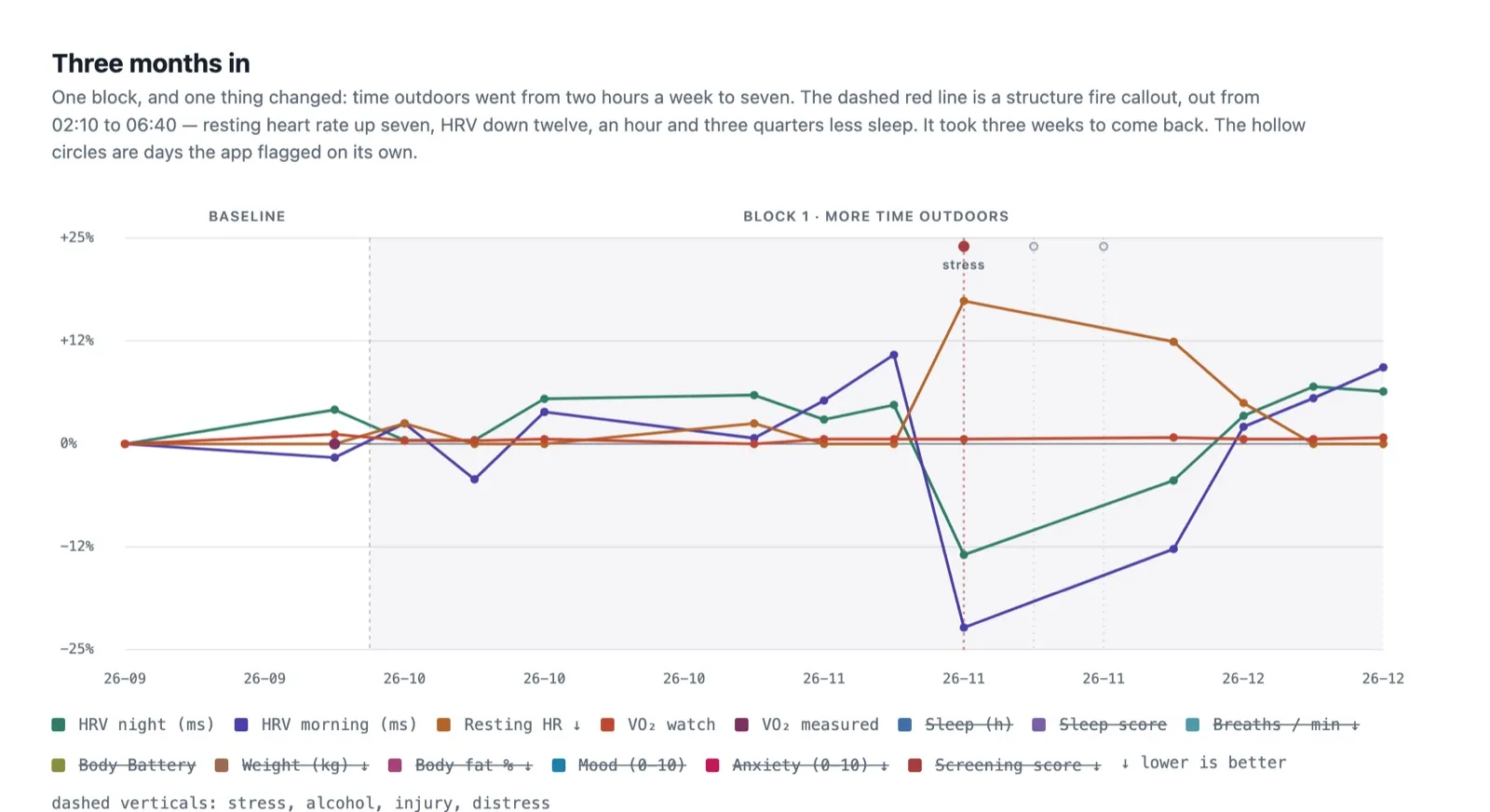 Three months. One block, one thing changed — time outdoors from two hours
a week to seven. The red dashed line is a structure fire callout, out from
02:10 to 06:40. Resting heart rate up seven, HRV down twelve, an hour and
three quarters less sleep, and three weeks to come back.
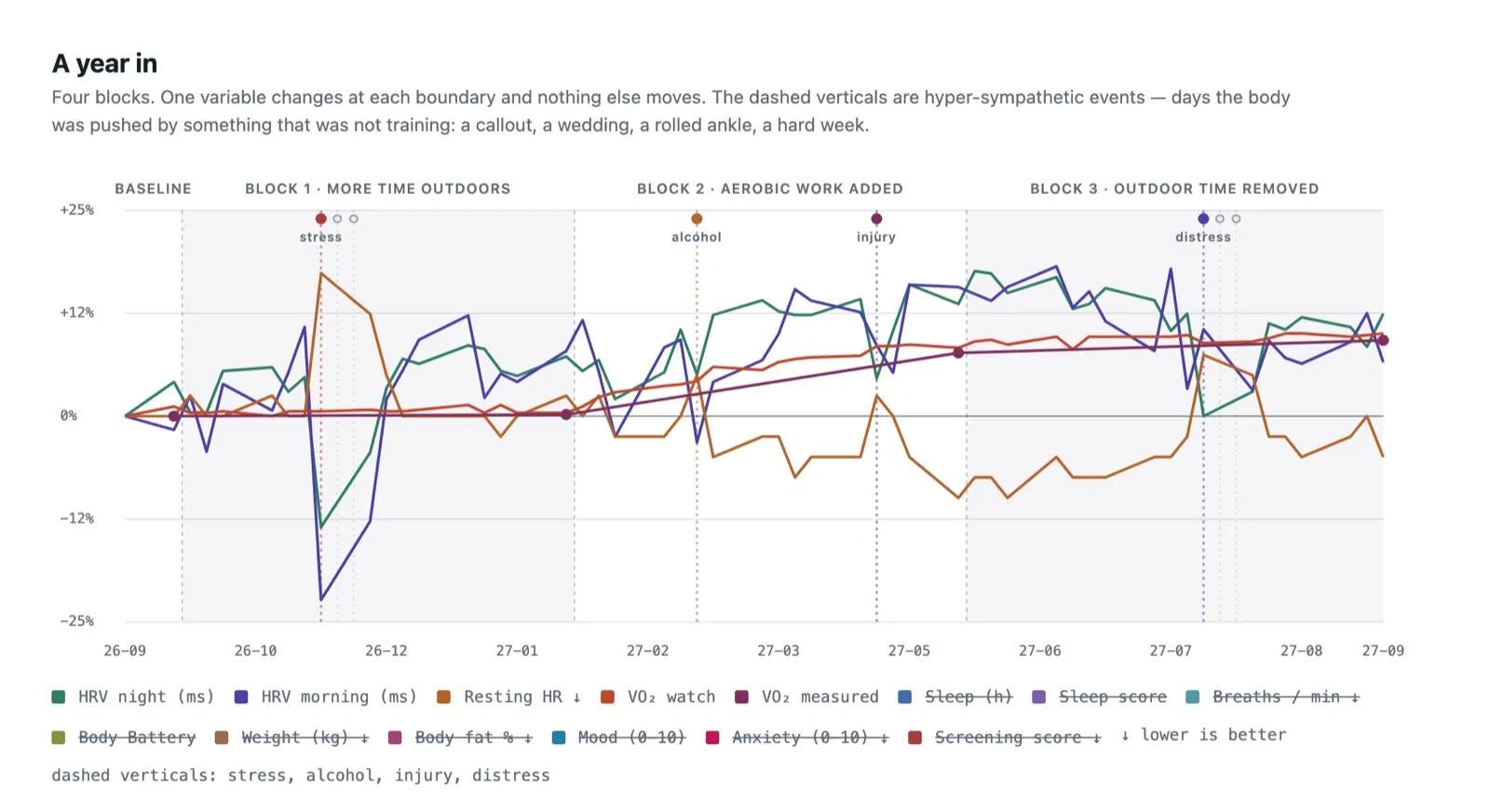 A year. One variable changes at each block boundary and nothing else
moves — outdoor time up, then aerobic work up, then outdoor time taken
away. The coloured verticals are hyper-sympathetic events: a callout, a
wedding, a rolled ankle, a hard week.
The days that were not training
Training is not the only thing that moves these numbers. A callout at two in the morning, a wedding, a rolled ankle, a stretch of weeks where life is hard — all of them put the body into the same state, and all of them show up in the same place: heart rate variability down, resting heart rate up, sleep short.
Those days are marked on the chart so a dip can be read against what actually happened instead of being blamed on the programme. The callout in the first block is the clearest one — everything drops at once, and it takes three weeks to come back.
You do not have to remember to log them. The app finds them by itself, because they look like what they are: a sudden run of unusual numbers with no training to account for it. A hard session earns a dip and the app leaves that alone. A dip on an easy week does not, and that one gets flagged. It then asks what it was, and you pick from a list — stress, alcohol, injury, distress, illness, travel. The hollow circles on the chart are days it flagged that nobody has named yet.
That distinction is the whole trick. Without it you cannot tell recovery from your programme apart from recovery from your life.
Pulled out on its own, with the other eight lines taken away, it looks like this.
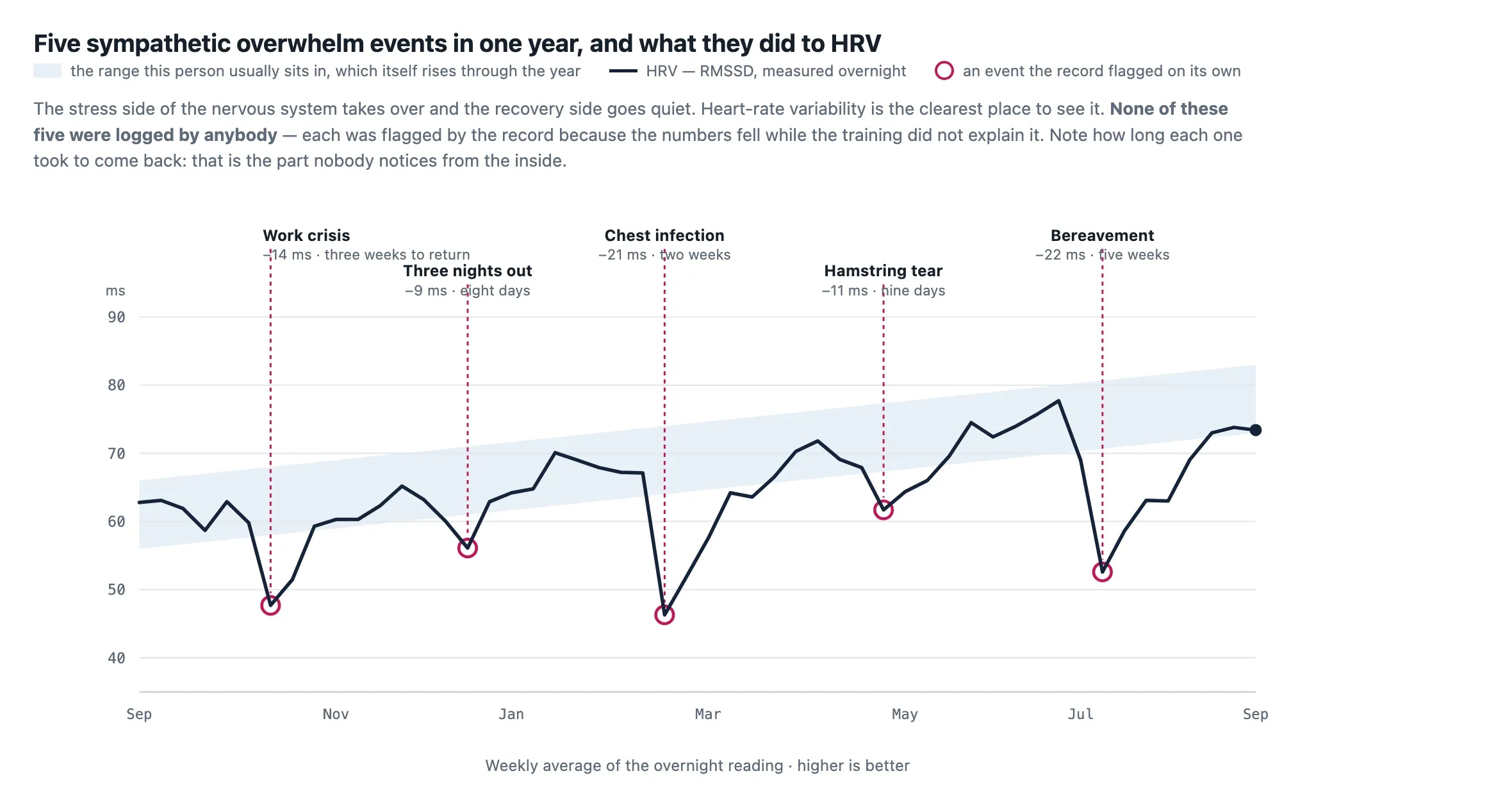 Five sympathetic overwhelm events in one hypothetical year. Every number
is invented, from the same sample client. The pale band is where this
person’s HRV normally sits — and note that the band itself rises, because
the training was working the whole time.
Read the depths against each other. Three nights out cost nine milliseconds and eight days. A chest infection cost twenty-one and a fortnight. A bereavement cost twenty-two and took five weeks, which is longer than the illness did.
The size is not the interesting part. The time is. Nobody needs a chart to know a bereavement is worse than a hangover. What a year of daily readings tells you is that the body was still measurably out of balance five weeks after an event the person had stopped talking about — and that a run of three nights out costs more than a week of recovery, every time, which is not what it feels like on the Monday.
None of the five were logged by anybody. Each was flagged because the numbers fell while the training did not explain it. The naming came afterwards.
Five big events, or fifty small ones
Five events is the easy case. Here is the harder one: the same year, the same training, and fifty drinking occasions instead — two or three most weeks, which is an ordinary amount for an ordinary adult.
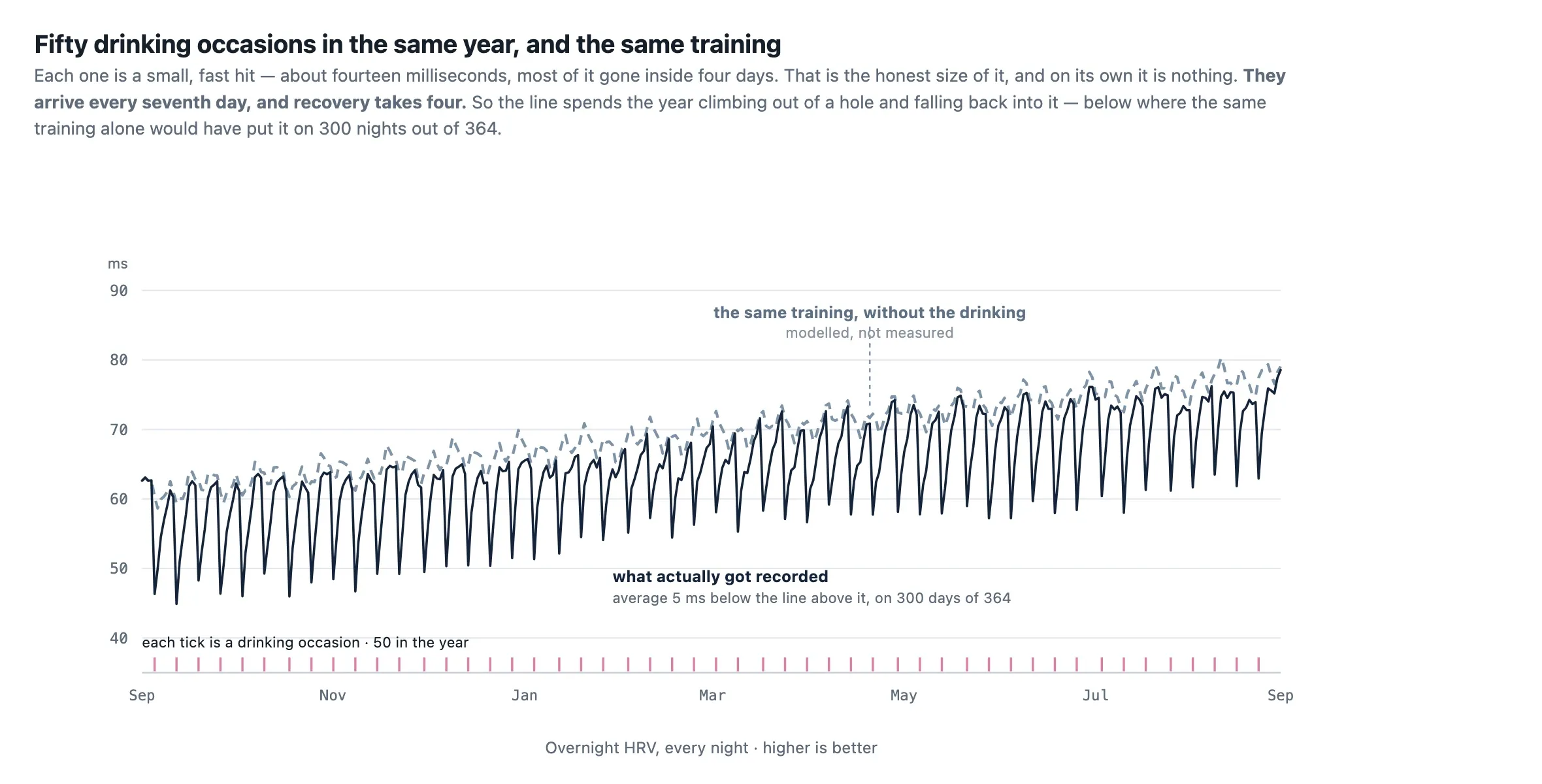 Nightly rather than weekly, so the shape is visible. Every number is
invented. The size of one night — about fourteen milliseconds — is set from
Grosicki and colleagues, who
found 3.3 to 3.8 ms of HRV per drink above a person’s own average across 5.1
million person-days.
No single one of those nights is a problem. Fourteen milliseconds, mostly gone in four days. Nobody would call that a health event and nobody feels it by Wednesday.
The problem is the spacing. They arrive every seventh day and recovery takes four, so the body is never given a clean run at the adaptation it is being asked for. Across the year the record sits below the modelled alcohol-free line on three hundred nights out of three hundred and sixty-four.
The heavy drinker
Same year again. Same training, same programme, same person. The only thing that changes is how often.
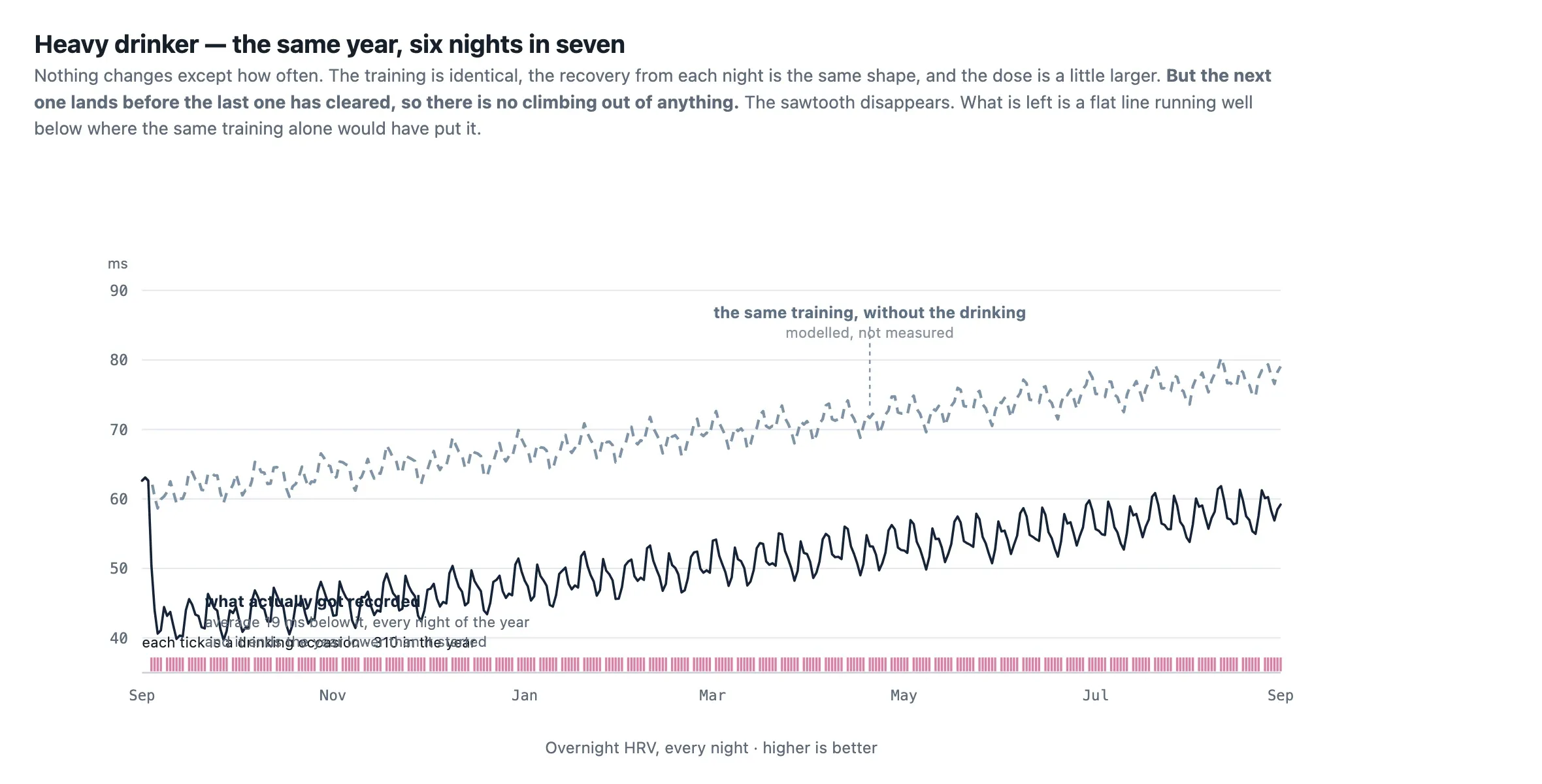 Six nights in seven, 310 occasions. Every number is invented, and the
suppression is capped at a third of baseline — the far end of what has been
reported, not past it.
The sawtooth is gone. That is the finding. In the chart above, every occasion was followed by four days of climbing back out; here the next one lands before the last has cleared, so there is nothing to climb out of. The line does not spike and recover. It just sits down.
It averages nineteen milliseconds below the alcohol-free line on 361 nights out of 364. Not on the bad nights. On all of them.
And it ends the year lower than it started. A full year of training — the same blocks, the same progression, the same work — and the recovery number is worse in September than it was the September before. The training was never the problem. It never got a night to land in.
What the chart does not claim. The dashed line is modelled, not measured, and it assumes the training effect itself is unchanged — only that the acute hits are subtracted from it. Whether repeated drinking also blunts the adaptation is not settled in the literature, and this diagram does not pretend to settle it. The full account, with the studies, is in what weekly drinking does to a year of training.
What each block did to anxiety and depression
That chart has nine lines on it, and the two that matter most get lost. So here they are on their own, and because only one thing changed per block, each step can be read on its own.
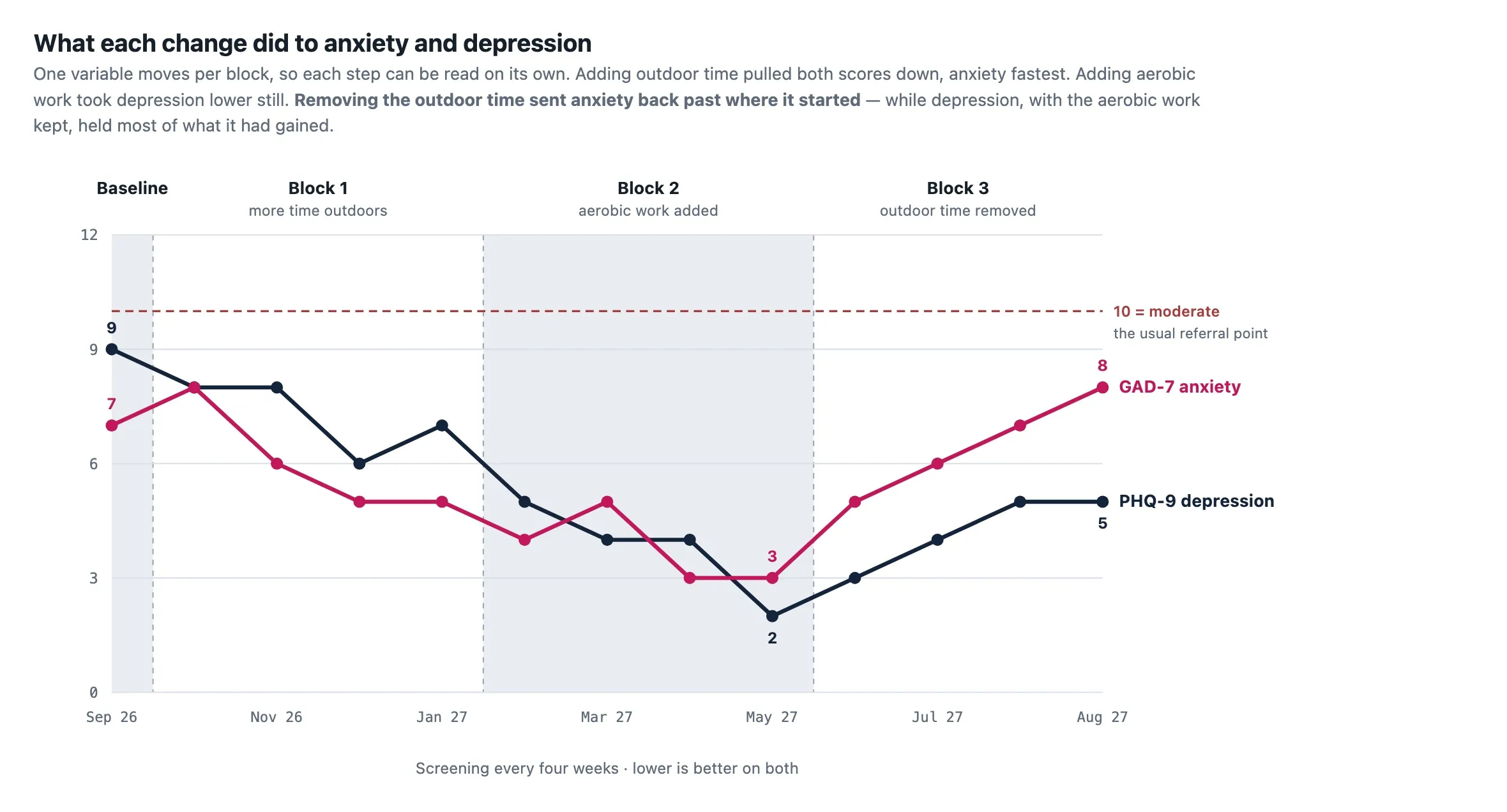 Both scored so that lower is better. The dashed line at ten is the usual
referral point.
Read it left to right.
The first month got worse, not better. Anxiety went from seven to eight before it moved the other way. That is normal and it is the reason a baseline is two readings rather than one: a single number tells you nothing about which way a person was already going.
Block 1 added outdoor time — two hours a week to seven — and changed nothing else. Anxiety responded fastest, eight down to five inside two months. Depression moved more slowly and less steadily; it was still at seven in January, above where anxiety had already settled.
Block 2 added aerobic work on top of it. This is where depression came down hardest — seven to two by May, the lowest reading of the year — while anxiety flattened out around three and stayed there. VO2 max climbed four points through the same block.
Block 3 took the outdoor time away and left the training alone. Same lifting, same running, same hours in the gym. Anxiety went the whole way back and past it — three to eight, one point worse than the September it started at. Depression rose too, but only to five, and held most of what it had gained.
That is the finding, and it is why one thing changes at a time. The two scores did not move together and they did not move by the same amount. On this record, the time outdoors was doing most of the work for anxiety, and the aerobic work was doing most of it for depression — which is why taking one away hurt one score far more than the other. Through that last block aerobic fitness kept improving and HRV stayed high; the body was in better shape at the end of the year than the beginning.
Had all three changed at once, the year would have shown a rise and a fall and told you nothing about which part mattered. Nobody could have told you this from how they felt, either. You only know because the same question was asked the same way every four weeks, and because only one answer moved at a time.
Try RizunResilience-Daily
A practice copy of the daily entry, right here on the page. Type in it, change things, get it wrong. Nothing is saved and nothing is sent anywhere — reload the page and it is gone.
What it turns into
One row like this per day. On its own it means very little. Ninety of them in a row is the thing you are actually paying for — a record long enough to show whether what we changed did anything.
Ask for the free consultation
Twenty minutes, no charge, no commitment. Fill this in and it opens an email to me with your answers already in it — you press send. Nothing is stored anywhere on this page.
Open the emailIt goes to rizunresiliencetherapy@gmail.com. If nothing happens, email me there directly.
Please do not put medical history in this. The health questions come later, on paper, in person. What you can expect is on the privacy page.
Ask for the free consultation20 minutes, no charge. Your goals, an introduction to Resilience Therapy, and a chance to meet each other. Everything after it — the intake, the testing, the training and the findings sessions — is the one rate: $88 CAD per hour.