How it works — remote
A tracking and analysis programme. You do the training; the measurement, the analysis and the answers are mine. It suits people who already know how to train.
Remotely, this is a tracking and analysis programme. You do the training. I do the measurement, the reading of it, and the answer to what actually changed this.
That is the product. Not sets and reps emailed to you — those you can get anywhere, free. What you cannot get anywhere is somebody taking a year of your own numbers seriously.
Who this is for
People with a fair athletic base and a working knowledge of strength training. You have trained before. You know a hinge from a squat. You can tell when a movement has gone wrong before it hurts.
People who want to optimise their health and recovery, rather than learn to train from nothing.
People who are already motivated. Remote does not supply motivation and I will not pretend otherwise. It supplies structure, measurement and answers. You still walk into the gym on your own.
Who should not start here, and why
If you are new to the gym, this is the wrong first step. Not because anyone is being excluded — because it will not work.
You need:
- A general knowledge of strength training. The names of the movements, roughly how a programme is built, what a working weight is.
- Fair proprioception. You know where your body is and what it is doing. You can feel whether the right muscle is working.
- To know how to engage. Told to brace, or to keep tension through the hip, you can do it — not perfectly, but you know what is being asked.
Without those, nobody can coach you down a video call. I cannot see the knee drifting in, the ribs flaring, the bar path wandering an inch. In a room I would catch those in a second. Through a phone propped against a water bottle, I will not.
Work with a personal trainer in your area first. A few months of hands-on coaching, learning the movements with somebody who can put a hand on your back and say there, that. Then come back.
That is not a brush-off. It is the order that works, and telling you otherwise would be taking your money for something I cannot deliver.
What the analysis actually does
This is the part worth paying for, so here is what it means concretely rather than as an adjective.
It finds what moved with what. Every measure you log gets compared against every other one, across your whole record. Not a feeling that you sleep badly after drinking — the size of the effect, in your data, with how confident anyone should be about it.
It catches the days you did not flag. When your HRV, resting heart rate and sleep all move the wrong way at once and your training does not explain it, the record marks that day on its own. Illness, a bad week, a night that went long — found automatically rather than remembered later.
It reads the blocks against each other. Twelve weeks of one thing, then twelve weeks with one variable changed. Four blocks in and the chart shows what each change did to your recovery, your mood and your anxiety scores, separately.
It puts you against the country. Where your numbers sit against Canadian population data, by age and sex, rather than against nothing.
It is written up, not exported. A twelve-week findings session — ninety minutes going through what the block did. Not a spreadsheet, an explanation.
The conditions have to be controlled, and that part is on you
This is the thing most likely to make remote fail, so read it before you buy anything.
In the laboratory I control everything: the same machines, the same time of day, the same room temperature, the same person operating them. That is not fussiness. It is the only reason two numbers three months apart can be compared at all.
Remotely, you are the instrument operator. Nobody is standing behind you making sure it was done the same way. So:
- Same time of day, every time. Body weight swings a kilo or two between morning and night. Grip strength is lower when you are tired. A reading taken Tuesday morning and compared to one taken Friday evening is not a comparison.
- Same conditions before it. Before food, before coffee, before training. Pick a state and keep it.
- Same equipment. The same gym, the same machines, the same scale, the same tape measure. Different equipment produces different numbers from the same body, and nothing in the analysis can tell those apart.
- The morning HRV reading lying down, before you get up. Not sitting, not standing, not after you have looked at your phone. Supine agreement with a hospital ECG is near perfect and sitting up measurably degrades it — the numbers are here.
- Same light and distance for any photo, and the same posture, relaxed rather than braced.
A measurement taken in different conditions is not a slightly worse measurement. It is a different measurement, and mixing the two buries a real change under noise you created yourself.
None of it is hard. It is a habit, and it takes the same two minutes either way. But it is the difference between a year of data that answers something and a year of data that answers nothing — and it is the one part I cannot do for you.
Both apps are yours, and both are free
In person, only the daily record goes home with the client — I run the assessment app myself on the testing days. Remotely there is nobody in the room, so you run both.
RizunResilience-Daily is the daily one. A couple of minutes an evening, most of it arriving from your watch.
RizunResilience-Assess walks you through your own testing days: the warm-up, what weight to start each machine at, and the ladder up from there. In the gym I would be telling you that. At a distance the app does.
Neither costs anything extra. They are in the block. No subscription, nothing to renew, nothing to cancel if you stop.
This is what the record actually looks like
Not a mock-up — these are the real charts, drawn by the app from a worked example. Every number in them is invented; the client is a sample built to show the shape of a year, not a real person. Yours starts empty.
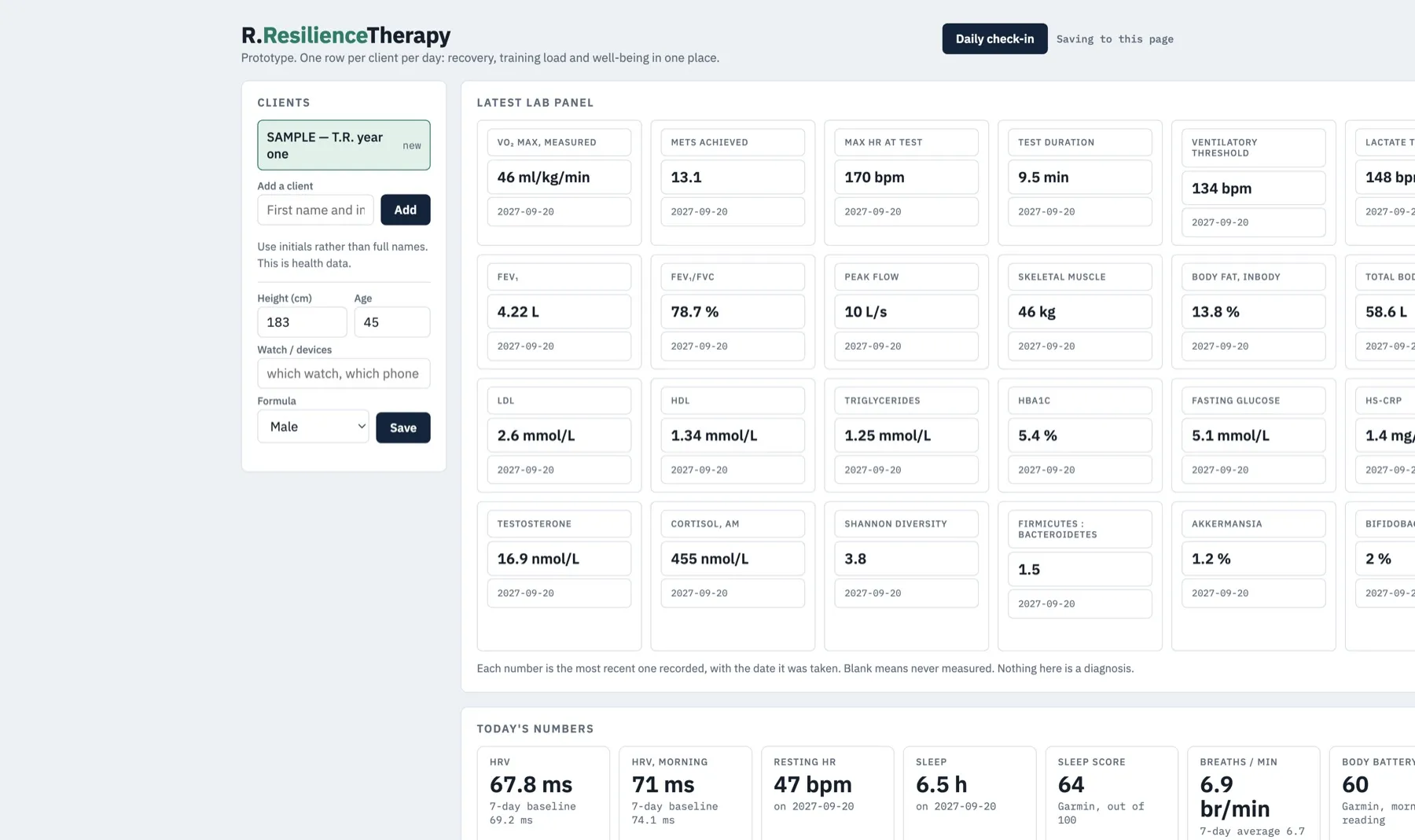 The daily entry. Most of it arrives from the watch.
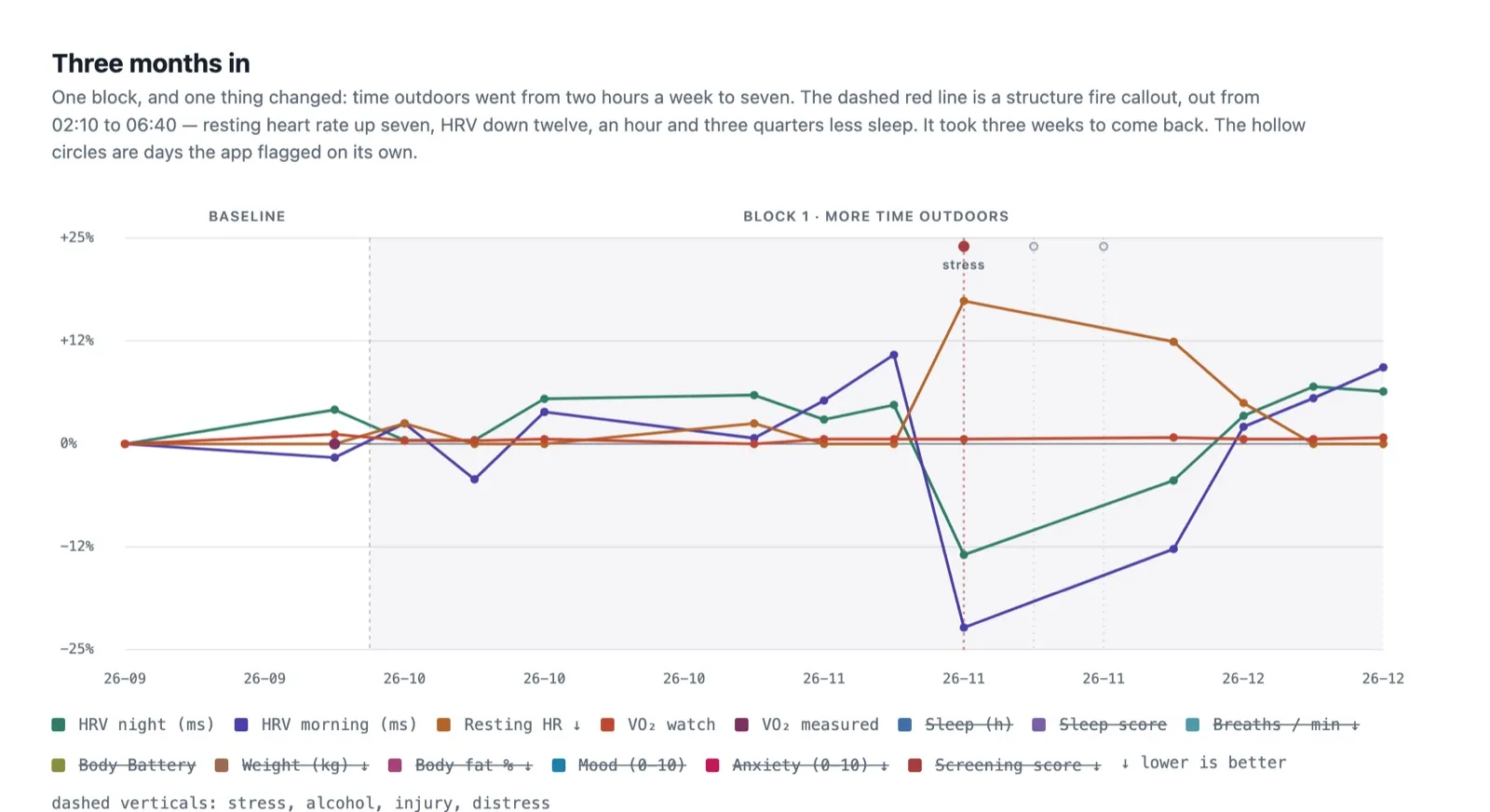 After one block. Nine measures, each as a percentage change from your own first reading.
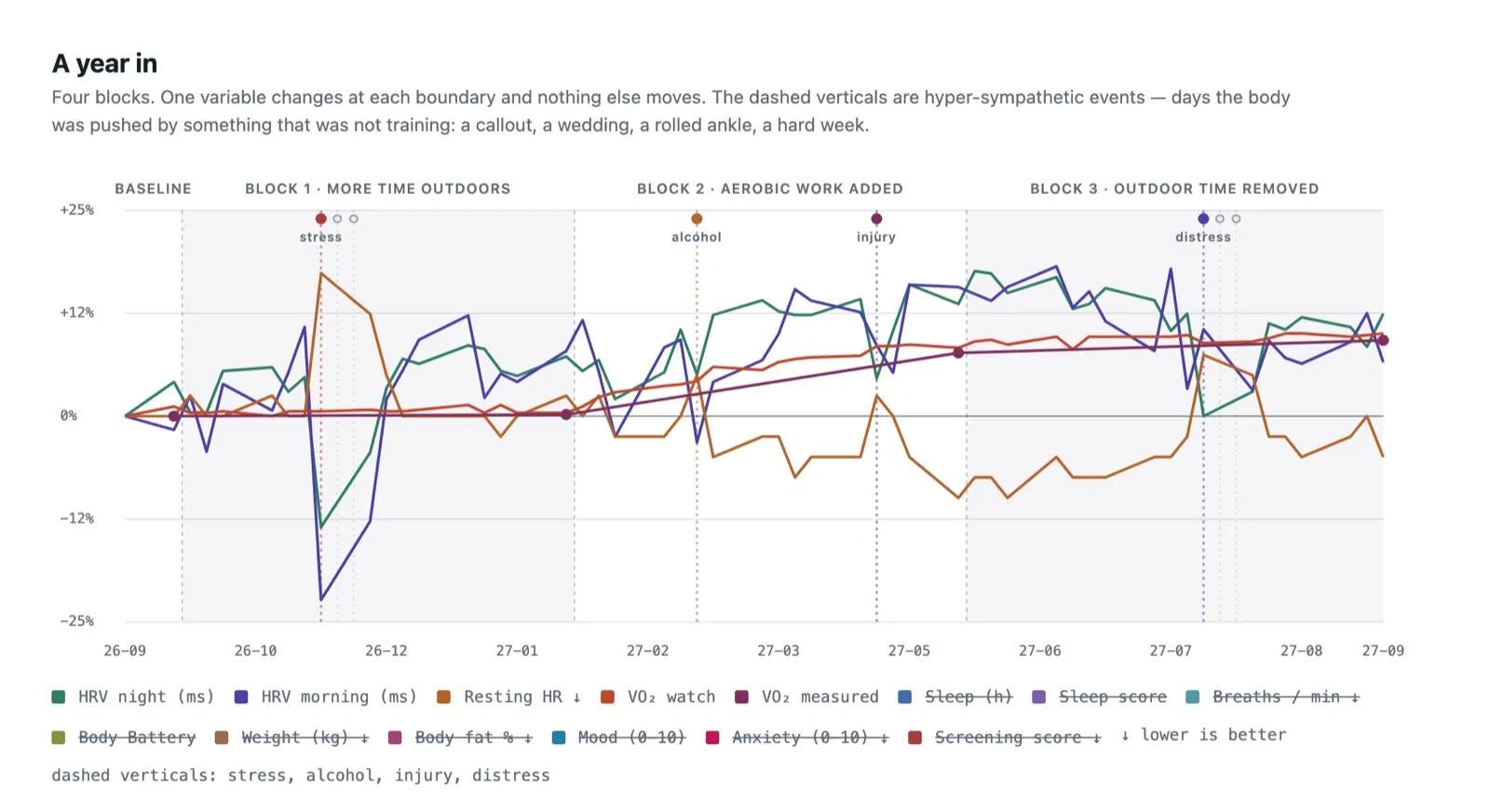 After a year. Four blocks, and the dotted lines are where something changed.
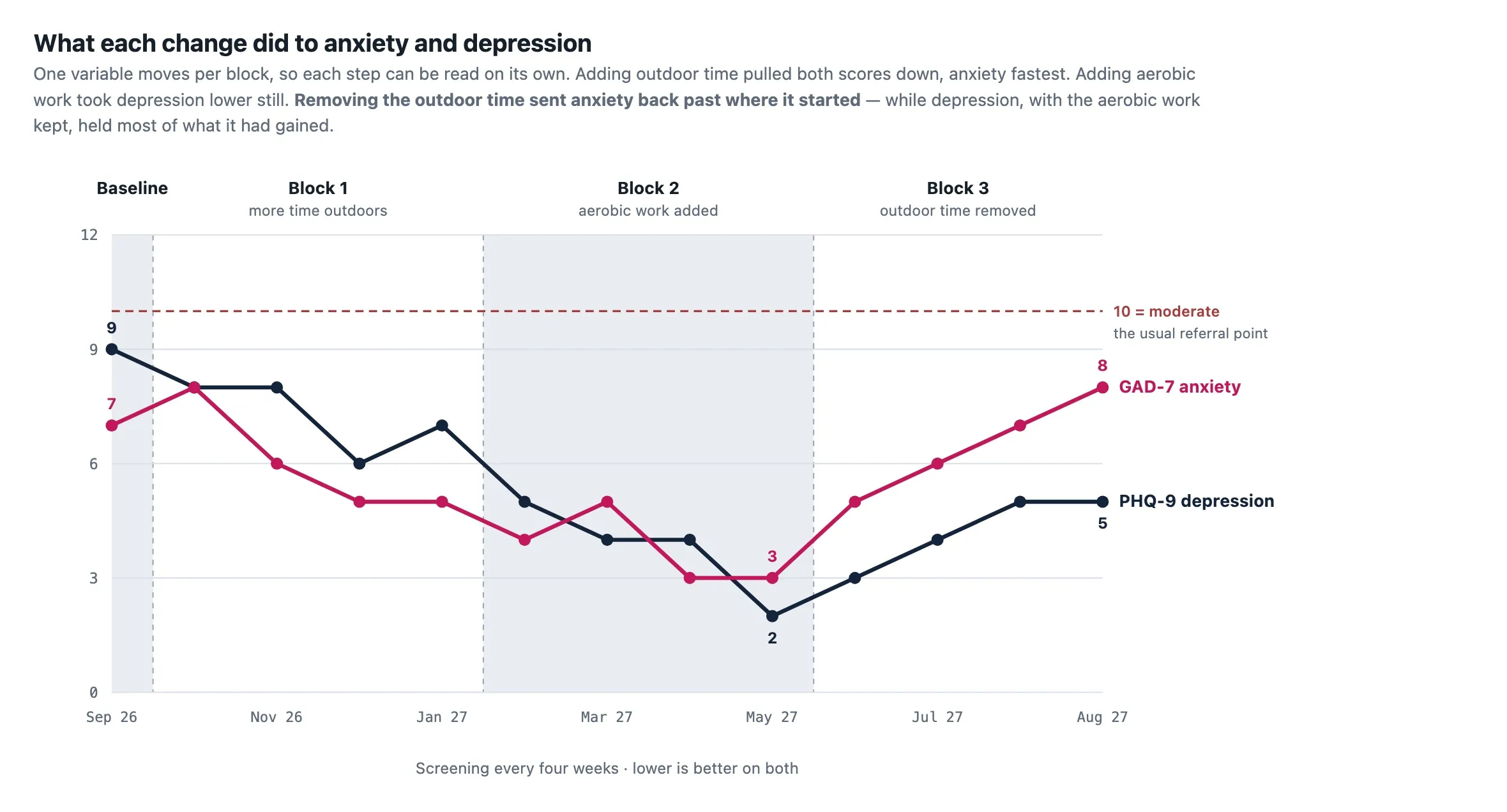 And what each block did to anxiety and depression, separately. They do not move together, and that is the point — this is the chart the whole thing exists for.
Why it gets better the longer you stay
A year of your data answers questions that three months cannot.
Three months tells you whether something moved. A year tells you whether it moves every winter. Two years tells you what your body does with age, with a change of job, with a bad season — and what reliably pulls it back.
Most tracking apps show you last week. The point of this one is the shape of several years, and that only exists if somebody keeps it properly from the start.
And the comparison set grows too. Every client block adds to what the next reading can be measured against. That work is heading for publication eventually — see future research — and nobody’s data is ever used for it without separate written consent, asked on a different day, and never on day one. Your tracking does not depend on agreeing to any of that.
What stays exactly the same as in person
- The daily record. Same app, a couple of minutes an evening, same 24-hour window. Your watch does most of it.
- The screening. PHQ-9, GAD-7, DASS-21 and WHO-5, asked the same way at the same points, questions reordered each time.
- The twelve-week block, one variable at a time. This is the method and it survives the distance intact.
- The twelve-week findings session. Ninety minutes, by video instead of across a desk.
What is different, stated plainly
There is no physical assessment. No VO2 max, no lactate threshold, no body composition on the InBody, no grip strength on a calibrated dynamometer. Those need the mobile metabolic laboratory and they need you in front of it.
Your VO2 max is estimated, not measured. Your watch will give you a number and it will move over a block, and that is genuinely useful — it is worth tracking and we will track it. But a Garmin works it out from the relationship between your heart rate and your pace. Nothing is measuring the air you breathe.
A real test puts a mask on you and measures the oxygen going in and the carbon dioxide coming out, breath by breath, while the work gets harder. It returns things an estimate cannot produce at all — your ventilatory thresholds, your respiratory exchange ratio, whether you actually reached a maximum or just stopped.
So a remote block can show you the direction your watch thinks your fitness moved. It cannot hand you a measured number, and the two should not be written in the same column.
Your measurements are self-taken. The tape test instead of the InBody. Your own scale. Your gym’s equipment rather than the same machines every time. That is workable — it is exactly the compare-yourself- to-yourself argument this whole practice runs on — but only under the controlled conditions set out above. That section is not padding.
I cannot see your form. Video helps and I will ask for it. It is not the same as being there, which is why the entry bar above exists.
What you need at your end
- A gym you can get to consistently. The same gym if possible; machines differ between rooms and that shows up in your numbers.
- A wearable. A Garmin watch is the preference — it produces the overnight numbers without you doing anything. HRV4Training on a phone covers the morning reading.
- A tape measure, and the discipline to use it the same way.
- Honesty in the log. A blank is always better than a guess. A number remembered three days later is not a measurement, it is a reconstruction, and it will quietly wreck the comparison you are paying for.
The shape of it
- A free consultation, by video. Twenty minutes. We work out whether remote suits you at all — and if it does not, I will say so.
- Intake, by video call. History, injuries, medications, goals. Forms signed and returned before anything is programmed.
- Two baseline days on your own, at least a day apart, in the app.
- Your own baseline measurements — tape test, body weight, and whatever field tests your gym and your history make sensible.
- The block starts, and you log it daily.
- Twelve weeks.
- Reassessment, and one thing changes.
- The twelve-week findings session — ninety minutes, by video.
Then it repeats from step five, with better information each time. The record keeps growing, and it gets more useful every year it runs.
What I am actually selling, remotely
A way of finding out what works for you specifically, rather than what worked for somebody in a study.
You become your own experiment. The instruments are cheaper and the conclusions are narrower than they would be in the laboratory, and within those limits the method is identical — and the record outlasts any programme.
If those limits sound like too much compromise, come to the Shuswap and do it properly. If they sound reasonable, they probably are.
What it costs
Sold as twelve-week blocks, not by the hour. Twelve weeks is the point at which the data starts answering things, and it is the unit the whole method is built on.
First twelve-week block
$750 CAD
Intake, baseline, tracking set up, your programme written, the block reviewed as it runs, and the ninety-minute findings session at the end.
Pay for this blockEach block after that
$600 CAD
The next twelve weeks, built on what the last block showed. Same review and the same twelve-week findings session; the setup is already done.
Pay for this blockPrices in CAD. No GST — Trevor is a small supplier and not registered. Start with the free consultation; nothing is paid until we both agree remote is right for you. If you need to stop partway through a block, the unused weeks become a credit toward the next one — the rates page sets that out.
Ask for the free consultation
Twenty minutes, no charge, no commitment. Fill this in and it opens an email to me with your answers already in it — you press send. Nothing is stored anywhere on this page.
Open the emailIt goes to rizunresiliencetherapy@gmail.com. If nothing happens, email me there directly.
Please do not put medical history in this. The health questions come later, on paper, in person. What you can expect is on the privacy page.