The tape test
The body-fat estimate the US Navy has used since 1984, worked out here in your browser. Free, no equipment but a tape measure, and nothing you type leaves this page.
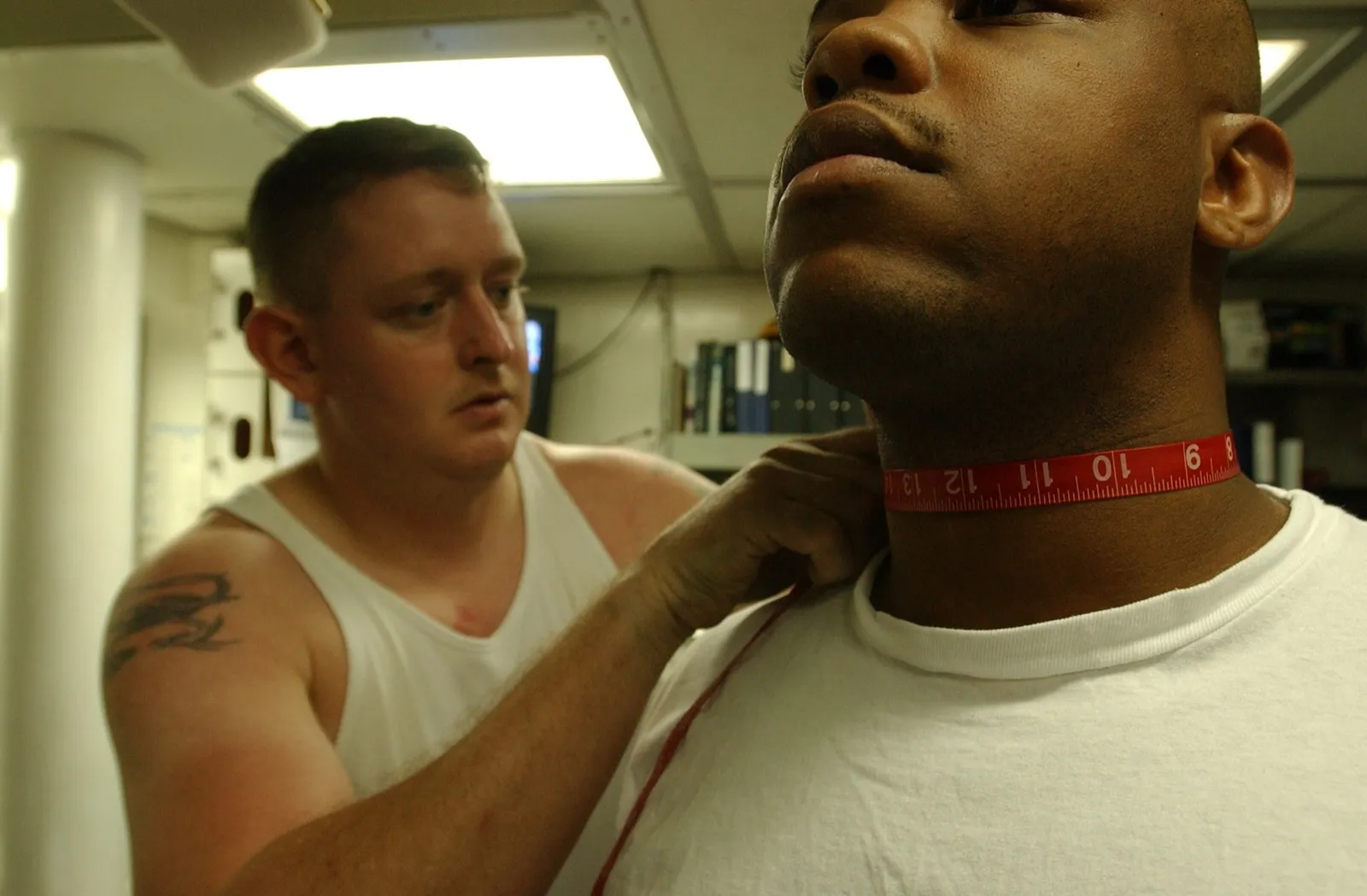
Where this came from
In 1984 two researchers at the Naval Health Research Center in San Diego, James Hodgdon and Marcia Beckett, went looking for a way to estimate body fat that did not need a laboratory. They measured a lot of sailors both ways — with a tape, and by the underwater weighing that was then the gold standard — and worked out an equation that turned a few circumferences into a percentage.
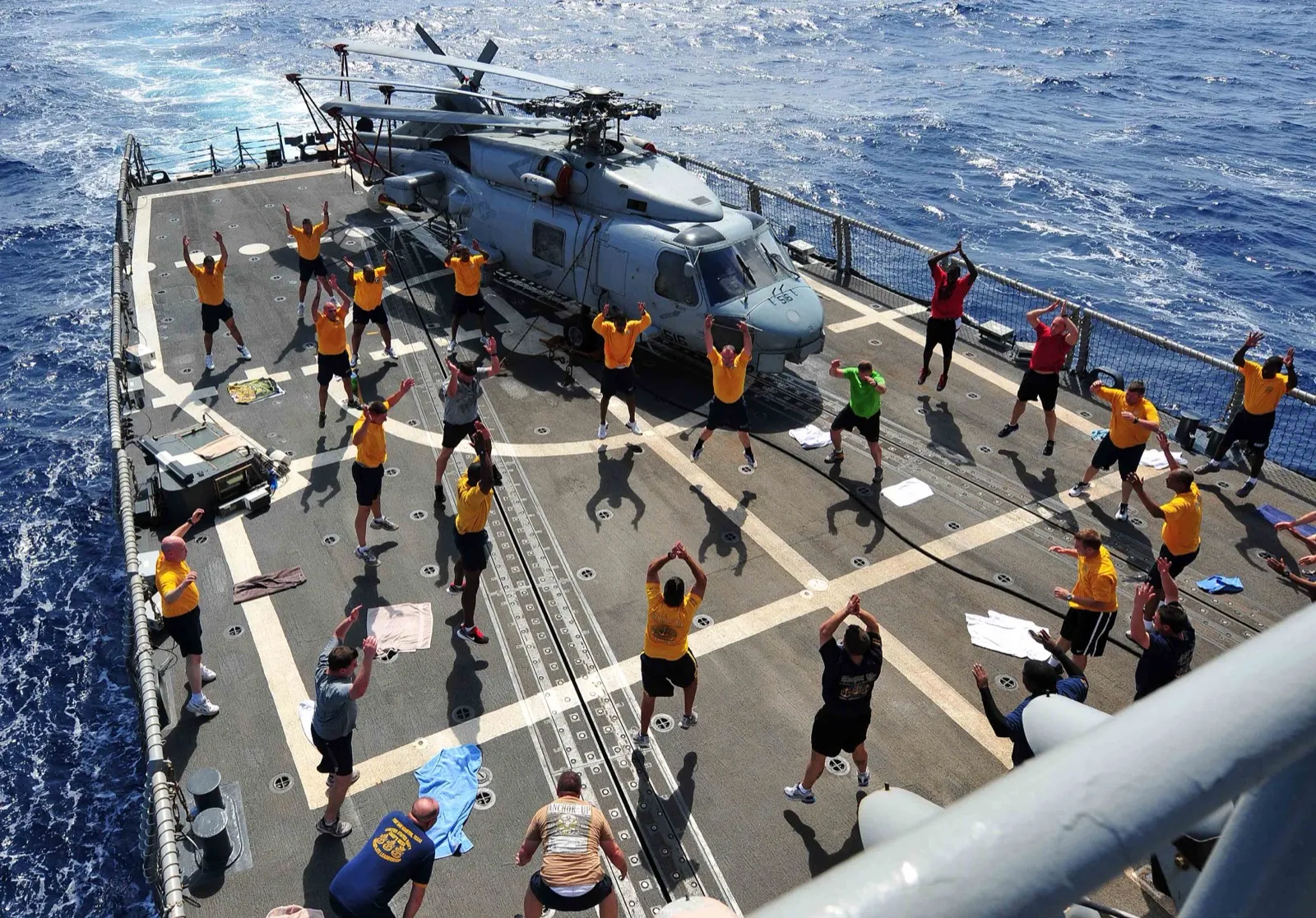
The reason it caught on is the reason it is on this page. It needs a tape measure and nothing else — no power, no calibration, no scale to level, no technician. It could be done to a whole ship's company in an afternoon, at sea. Two reports came out of that work: 84-11 for men and 84-29 for women, and the arithmetic in the box below is still theirs, unchanged, forty years on.
It is also the most-used body composition method there has ever been, by a wide margin, simply because the American military has run it on hundreds of thousands of people twice a year for four decades. That is why it has been studied so hard, and why we know its faults as precisely as we do.
One honest note. The Navy has revised its own procedure more than once since 1984 and what it does today is not exactly this. That does not make the 1984 equation wrong; it makes it a well-understood field method rather than current military policy. It is used here on its merits, not on its badge.
Read it for yourself
- Body composition standards in the military servicesThe chapter on where the standards came from, in the Institute of Medicine’s Body Composition and Physical Performance (Marriott & Grumstrup-Scott, 1992). Free, full text.
- Circumference-based predictions of body fat revisitedPotter et al., Frontiers in Physiology, 2022. Six hundred Marines, tape against DXA. This is where the honest error figures below come from.
- What the tape misses over eight weeks of trainingA caution worth reading: over a short training block, circumferences did not track the body-composition change well.
- The Navy’s own physical readiness programmeWhat the Navy actually does today, which is no longer quite this. Official, and it changes; the guides are published there.
Take the test
A tape measure and two minutes. It costs nothing, and done the same way each time it will track a change in your body fat as well as most things that cost hundreds.
Measure like this
- Use a tailor's tape, not a builder's. Snug against the skin, not tight enough to dent it.
- Neck: just below the larynx, the tape sloping very slightly downward at the front. Shoulders down, do not flex — exactly as in the photograph above.
- Waist, men: horizontal, across the navel.Women: horizontal, at the narrowest part.
- Hips, women only: horizontal, at the widest part of the buttocks.
- Breathe out normally and measure at the end of the breath. Do not hold it, do not pull your stomach in. This is the step people get wrong, and getting it right is worth more than the tape you use.
- Take each one twice. More than half a centimetre apart, take it again.
What the number is, and what it is not
It is an estimate from an equation, not a measurement. When Potter and colleagues ran it against DXA scanning on six hundred Marines in 2022, it read about two and a half points low on men and one to two points high on women, and it was wrong in a predictable direction: it flatters lean people and undersells fat ones. Their own conclusion was that it is good enough to sort people in the field and not good enough to call research data. That is a fair description of what you are about to get.
Its value is in the change. Measured the same way, by the same person, at the same time of day, the direction it moves is trustworthy even when the absolute number is not. Compare it against yourself last month. Do not compare it against a friend's number, and do not compare it against a body-composition scanner — those disagree with this and with each other, and none of them is the truth.
And do not read it weekly. One of the studies linked above found that over eight weeks of hard training the tape did not keep up with what was actually happening to the body underneath. Months, not weeks.
This runs in your browser. Nothing is sent anywhere, nothing is stored, and reloading the page clears it.
Now measure it a second way →RizunResilience BF% reads your body fat from a photograph, puts this tape number beside it, and works out how far apart the two answers are. They will not agree. Finding out by how much is the most useful thing on either page.