Mobile LabComing soon

A mobile lab built into a Hino 155 box truck with a sixteen-foot box, so the testing comes to you instead of you driving to a city for it.
The box holds a treadmill and screens running trail footage, so a graded test is run on a surface and a view close to what you actually train on, and a lab desk for the equipment and the results. At a gym or a house the van plugs into the building’s power; a generator comes along for places that have none.
What’s in the van
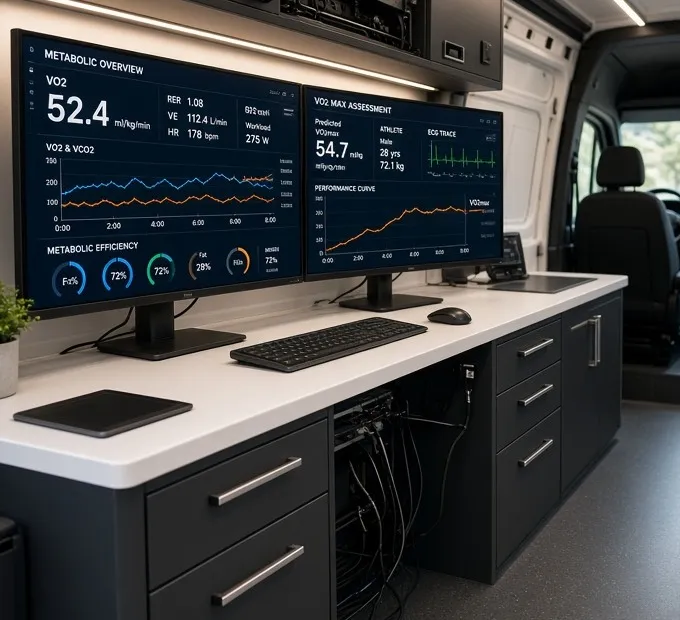
VO2 max — the VO2 Master. Built in Vernon, forty minutes from where these sessions happen. It is a wireless mask-based analyzer that reads oxygen uptake, carbon dioxide output, respiratory exchange ratio, ventilatory thresholds, and breathing rate live through a test, and it does it without the cart and tubing a laboratory system needs. That portability is the whole reason a van like this is possible at all.
Body composition — an InBody 270. Segmental bioelectrical impedance: ten impedance readings, two frequencies across each of five body segments, in about fifteen seconds. It reports skeletal muscle mass, body fat mass and percentage, total body water, and lean mass arm by arm and leg by leg.
No ionizing radiation, and that is not a small thing in practice. An X-ray method needs a licensed facility and a qualified operator, and each scan is supposed to be medically justified — the IAEA notes that scans done for athletic performance or a sports contract are not always. Impedance has no dose to justify. It can be run every week, every month of a season, on a whole roster, without anyone counting.
What decides a training question is not one reading but whether the same reading can be trusted six weeks later. An impedance scale’s absolute numbers sit on their own scale, so they are compared with themselves — this device, this person, over time — and not mixed with a reading taken on different equipment somewhere else.
Lactate threshold — finger-prick testing through a graded treadmill test. Blood is taken at each stage and read on a handheld analyzer; the Lactate Scout and Lactate Plus are the two units this kind of testing is normally run on, and each needs a drop of blood and about ten seconds. The result is where your aerobic and anaerobic thresholds actually sit, which is what training zones should be built from instead of a percentage of a guessed maximum heart rate.
Haemoglobin. Also from a finger prick, on a point-of-care analyzer such as the HemoCue system. Low haemoglobin is common in endurance athletes and shows up as fatigue that training does not explain.
Teams
The same testing works for a squad. Because the van comes to the team, a whole roster can be tested where it already trains, rather than each athlete booking a clinic in a city on their own time.
Three points in a season:
- Pre-season — a baseline for every athlete before the work starts.
- Mid-season — what has changed since that baseline.
- Post-season — where the season left them.
Tested the same way each time, on the same equipment, the three sit next to each other and the season reads as a line rather than three unrelated appointments.
Teams in the area get a discounted rate.
What this costs everywhere else
Priced one at a time, at clinics in BC, as of September 2026:
- VO2 max test — $235. Scienced Athletics, Vancouver. A sixty-minute appointment around a fifteen-to-twenty-minute treadmill test.
- Lactate threshold test — $250. Same clinic. About an hour, with seven to ten finger-prick samples through the stages. Booked together with the VO2 max test, the pair is $285.
- DEXA body composition scan — $249, or $499 with a physician review. DexaCan, Kelowna.
- InBody scan — usually $25 to $60, and often free with a gym membership. A Toronto clinic charges $60 plus tax with a kinesiologist to read it.
- Private blood work — from about $89, depending on the panel. Private blood testing in BC runs from there upward; haemoglobin and ferritin are not covered by MSP when there is no medical reason to order them.
Add it up and the physiology alone is somewhere between six and eight hundred dollars, before the drive. The two clinics above are in Vancouver and Kelowna. From Salmon Arm that is a day and a tank of gas for the Kelowna one, and an overnight for the Vancouver one.
Starting out free
To start with, the testing is free. The van will be travelling around the Interior doing two things at once: collecting data, and letting people see for themselves what it can do. Most people have never had a VO2 max test or a body composition scan and have no particular reason to pay six hundred dollars for something they cannot picture. Free testing solves both problems — the dataset grows, and the testing stops being abstract.
The data is worth more than the fee right now. That is not generosity, it is the trade: the more people tested, the better the picture of what these numbers do across real training, and the better the programming gets for everyone after. See Rates and payment for how that fits with everything else.
Coming soon. The van is not on the road yet. If you want to be told when it is, get in touch.