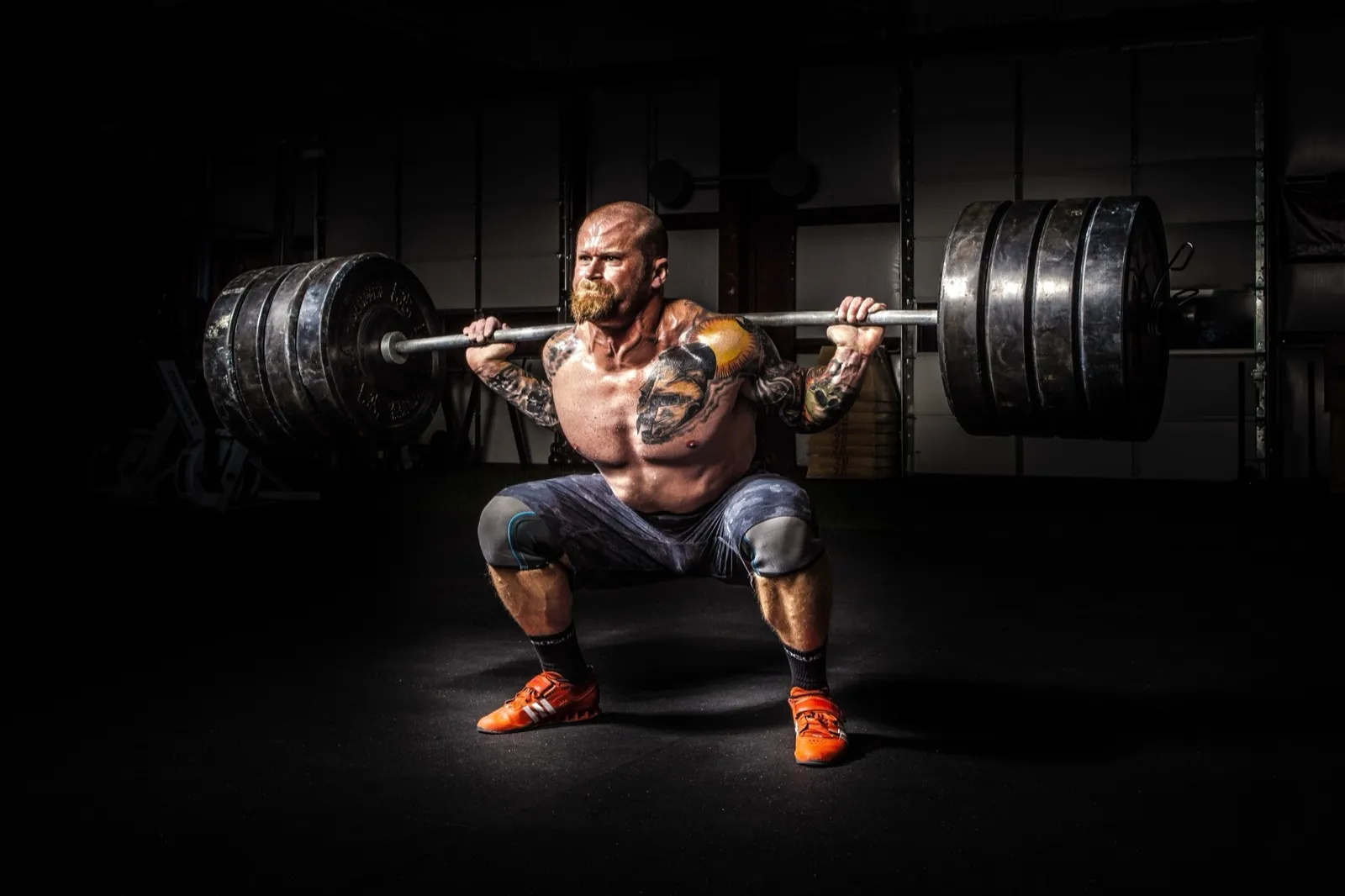
Strength and endurance in one career
Each of these on its own puts Trevor in a small group.
| Trevor | For comparison |
|---|
| Bench press | 465 × 3 | Elite line (stronger than 95% of lifters) at his weight: 380. Average: 212. |
|---|
| Squat | 475 × 3 | Elite line at his weight: 520, level with his estimated max. Average: 289. |
|---|
| Deadlift | 465 × 3 | Advanced line (stronger than 80%) at his weight: 494 for one rep. Average: 340. |
|---|
| Ultra marathons | 25+ | Fewer than 1 in 2,000 Americans finished one in 2025. |
|---|
| VO2 max | High 50s | Top-5% line for men 40 to 49 is 52.5. |
|---|
Strength Level's figures come from people who log their lifts in an app, so they are already stronger than the general public. Among American men, 35.2% do any strength training twice a week.
No study counts how many people bench 465 and have run twenty-five ultras. The estimate below follows the rarest things with published figures and counts everything else as free.
Doing the maths
- Finished an ultra in 2025 About 150,000 of 340 million Americans.1 in 2,300
- Races more than one a year Twenty-five in a decade takes it. 41% of ultra runners do.1 in 5,500
- Has benched at the elite line for his weight At most 2.2% of men: 44.5% of men aged 18 to 44, the age group most likely to, lift twice a week, and 5% of Strength Level's lifters reach elite.1 in 250,000
- And everything else Elite squat, top-5% VO2 max, resting heart rate in the high 30s, 13 to 14% body fat, three decades under the barbell. Counted here as certain for anyone who got this far. They are not.1 in 250,000
About 1 in 250,000 About 0.0004% of people, well under 0.01%. About 1,400 people in the United States; at the same rate, about 170 in Canada.
That is a ceiling, not a count. Every step leans toward counting too many people. Step 3 assumes ultra runners are as likely to bench heavy as other men, when training for endurance is known to blunt strength gains. Step 4 counts five rare traits as free.
No study has measured this combination directly. This is arithmetic on published figures. Read it as an order of magnitude, not a precise number.
Estimate sources: RunSignup; RunRepeat; CDC, National Health Interview Survey 2020; Strength Level; Hickson (1980), strength and endurance interference; Statistics Canada, population estimates
Sources: Strength Level; RunSignup; Garmin / The Cooper Institute; CDC, National Health Interview Survey 2020