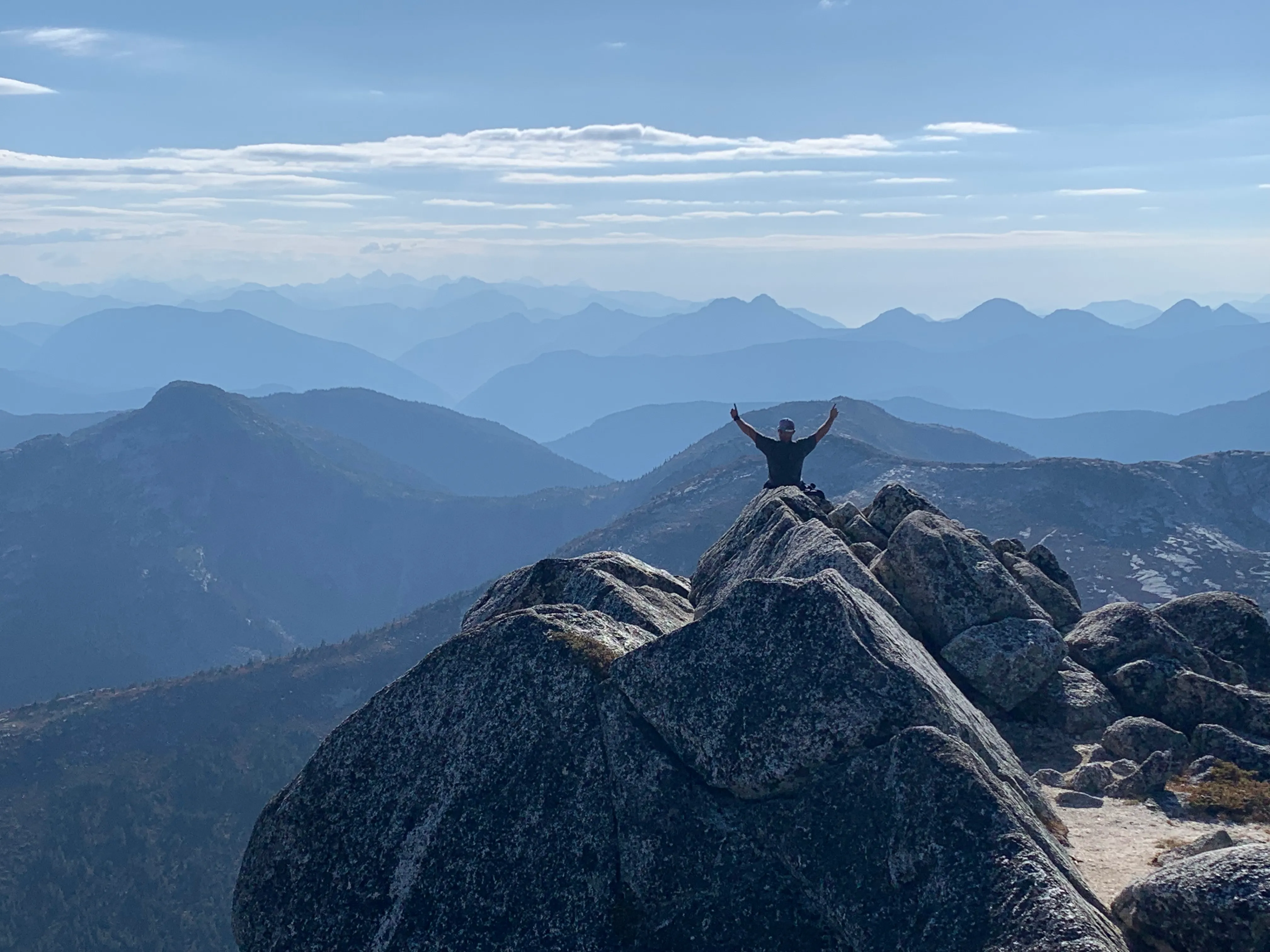
Episode 1
Ultra-Astral Travelling
What happens somewhere past the fifth hour of an ultra, when the body has settled into a rhythm and a part of the mind goes somewhere else entirely.
Running, hiking, cross-country skiing, skate skiing. Nature-based interventions, activities with a high cardio demand. Adapt to them, physically and mentally, and they can lead you to leave your body. To astral travel, while you are still moving.
For me it comes around five or six hours into an ultramarathon. I find my rhythm. My connection with the earth. My body moves at a pace my heart can keep up with, but fast enough to keep feeding me stimulus, in a state relaxed enough that I begin to perceive everything passively.
Every step over every rock and root. Every slope down, every curve in the trail. It all needs your full attention. And somehow you are no longer there. Your mind goes on autopilot. Some would call it a flow state.
One part of the mind is so stimulated that it leaves the other part behind. The creative part. The part with no concern for safety, or for the rocky steps in front of you. That part is free to explore. To go back into the past, or out into the future. To relive old events, or to live new ones that have not happened yet, but maybe have, in some alternate universe.
It becomes fully visual. Fully auditory. It becomes an out-of-body experience, a journey you do not realize you are on until it is too late.
Something brings you back. Not the trail conditions. Not a slip or a missed step. Usually an intruding thought — a worry about something superficial, something that does not matter, and certainly does not matter right then. How dare that thought rob you of your journey. Of who you were visiting with. Of the memory you were reliving.
But you are back in your body, back on the trail, and for a moment you do not know where you are. Where on the trail. And where you went.
Something happens at five or six hours of training, when the body and the mind are vibrating on another frequency. It is magical. It is spiritual.
And I would hope that everyone gets to feel it, and to feel our symbiotic relationship with Mother Earth, as our feet touch her back so elegantly, as we ride her spine down the mountains of our lives towards our destiny.
Ultra runningNatureSpirituality
Notes
Trevor is describing his own experience, not borrowing anyone else's. But people have been describing something close to this for a very long time, and usually through sustained, rhythmic, hard movement. These are the traditions that sit nearest to it.
- The marathon monks of Mount Hiei
- Tendai Buddhism's kaihōgyō, "practice of circling the mountain": 1,000 days spread over seven years, 30 to 40 km a day in the early years and 84 km a day in the seventh. In the fifth year comes the dōiri, nine days without food, water or sleep. Only 46 men have finished the full 1,000 days since 1885. The movement is not training for the practice. The movement is the practice. Source
- Rarámuri long-distance running
- The Rarámuri of the Sierra Madre in Mexico run rarájipari, kick-ball races covering enormous distances, held as ceremony rather than sport. Worth reading past the popular running books on them, which tend to flatten a living culture into a lesson about footwear.
- Running to the dawn
- Several Indigenous nations of North America, among them the Diné, run east toward the sunrise as a form of prayer, including as part of a young woman's coming-of-age ceremony. The running is the prayer; it is not accompanied by one.
- Shamanic soul flight
- Mircea Eliade's "Shamanism: Archaic Techniques of Ecstasy" (1951) gathered accounts from across the world of practitioners who leave the body and travel, almost always reached through sustained rhythm — usually drumming, held for hours. Anthropologists now argue Eliade flattened very different traditions into one story, so read him as a starting point rather than an authority.
- The Mevlevi turn
- Sufi samā', the ceremony behind the phrase "whirling dervishes", uses sustained rhythmic motion to reach fanā — the dissolving of the self. The same shape as an ultra: a body kept moving long enough that the person running it gets out of the way.
- The Jesus Prayer
- In Eastern Orthodox hesychasm, a short prayer is repeated in time with the breath, for hours and then for years, until it continues on its own and the mind "descends into the heart". A cadence, held until something else takes over.
- The subtle body
- Yogic and tantric traditions describe a sūkṣma śarīra, a subtle body within the physical one, and Patañjali's Yoga Sūtras list leaving the body among the siddhis, the powers that arise from deep practice. This is the oldest written version of the idea.
- Where the words come from
- "Astral" arrives in English through Helena Blavatsky and the Theosophical Society, founded 1875, who took it from Éliphas Lévi. Sylvan Muldoon and Hereward Carrington's "The Projection of the Astral Body" (1929) set out the modern account, and Robert Monroe's "Journeys Out of the Body" (1971) is what carried the phrase into ordinary speech. Source
- What science calls it
- Mihaly Csikszentmihalyi named flow. Arne Dietrich's transient hypofrontality hypothesis goes further and proposes a mechanism: hard, prolonged exercise takes so much of the brain's resources that the prefrontal cortex — self-monitoring, planning, the sense of time — quiets down, and what is left runs without a narrator. It does not explain the experience away. It describes the door.